


Art therapy / Psychological drawing
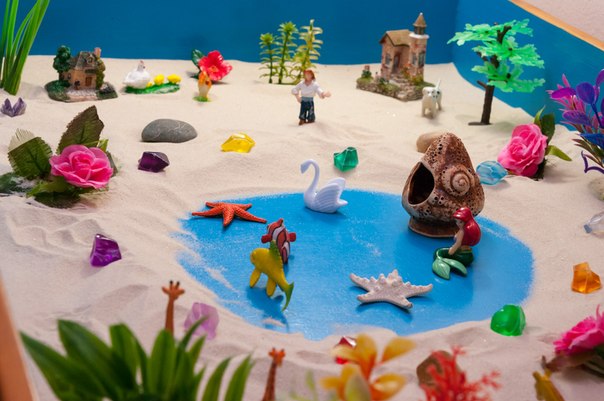
The first step is to demonstrate the sandbox.
We usually tell children the following. “Look, our sandbox is half full of sand, so you can see the blue sides. Why do you think this is necessary? Indeed, the sides symbolize the sky. The sandbox has another secret, if we push the sand apart, we will find a blue bottom. What do you think, why is this necessary? Indeed, the bottom symbolizes water. You can create a river, a lake, a sea, and even an ocean. And with the help of a jug of water, dry sand easily turns into wet sand. In a word, everything here is subject to your imagination.
The second step is a demonstration of a collection of figurines.
We usually tell children the following. “Look here for a wide variety of figurines. You can look at them, hold them in your hands. There are trees, and houses, and people, and much more. When creating your world, your picture in the sandbox, you can use different figures”
The third step is to get acquainted with the rules of sand games.
Teachers often ask these questions. “How to teach children to respect the sand? How to forbid throwing sand in the eyes of comrades? How to explain that it is impossible to destroy what was created by others? Indeed, sand games put forward a significant number of restrictions and prohibitions. To avoid moralizing, we recommend that children be introduced to the rules in the context of some kind of ritual, a constantly repeated action in which these rules are lived and played out.
The fourth step is the formulation of the topic of the lesson, instructions for games, the main content of the lesson.
This step is carried out by a fairy-tale hero (Sand Man, Fairy, turtle Tortila, etc.). He sets the topic of the lesson, on his behalf a fascinating story is told about an event, he formulates tasks and makes riddles. In other words, all educational material is presented to children by this fairy-tale character. He also leads the game process, controls its course, summarizes and analyzes the results of creative work, “crowns” and encourages each of the guys.
The fifth step is the end of the session, the exit ritual.
Completing work in the sandbox, the children dismantle their buildings, arrange toys on the shelves of the rack; they level the sand, put their palms on the surface of the sand and say words of gratitude.
Articles on the history, fundamentals, applications, and various forms of art therapy can be found here.
Only the best offers, interesting company news, useful innovations and no spam!