


Art therapy
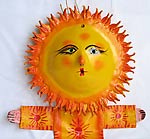
The most ancient cosmic symbol, known to all peoples, means life, the source of life, light. Such characteristics as supremacy, life-creation, activity, heroic principle, omniscience are associated with solar symbolism. The solar cult is most developed in the Egyptian, Indo-European, Mesoamerican traditions. The image of a solar deity moving in a chariot drawn by four white horses has been preserved in Indo-Iranian, Greco-Roman, and Scandinavian mythology. At the end of the Roman era, many deities were endowed with solar characteristics (Mithra, Christ). The Roman holiday in honor of the deity Sol Invictus (the invincible Sun), celebrated on December 25, the day of the winter solstice, passed into Christianity as the feast of the Nativity of Christ.
In Augustine and Gregory of Nyssa, the symbolism of this holiday is associated with the birth of a new light of the world and the disappearance of darkness. The sun often acts as the original symbol of the supreme deity or is identified with it. In ancient Egypt, the sun god Ra is the presiding deity of the pantheon. The sun crosses the celestial ocean – at dawn it is the young god Khepri, at the zenith – Ra, the sun god in the prime of life, at sunset – the old god Atum. In the Indo-European tradition, the sun personified the supreme deity. In various traditions, it is described as the “eye of the sky” (or the deity of the sky): in India, Surya is the eye of Varuna; in the Greek tradition, the sun appears as the “all-seeing eye of Zeus” (in Homer); in Persia it is the eye of Ahuramazda; in German mythology – “the eye of Wotan (Odin)”.
The sun is the giver of light and life, the ruler of the upper and lower worlds, which he bypasses during his daily circulation: “Although you are far away, your rays fall on the earth; although you are on the faces of people, your traces are invisible”; “The world exists through you,” say the hymns of Akhenaten, addressed to the solar god Aton. Solar deities and divine personifications of the sun are endowed with the attributes of omniscience and omniscience, as well as supreme power. The all-seeing eye of the solar deity embodies the guarantee of justice. It sees everything and knows everything – this is one of the most important qualities of the solar deity. The Vedas sing of the great god Surya, all-knowing and all-seeing, before whose face the stars disappear like thieves. One of the Vedic hymns dedicated to the sun says: “Here it rises, the wondrous eye of the sun, water and fire, the focus of the power of the gods, it fills the sky, earth and air with its radiant network, it is the soul of everything that moves and does not move.” Surya banishes not only darkness, but also diseases and bad dreams. Because of its almost universal association with enlightenment or illumination, the sun acts as a source of wisdom. These qualities – beneficial action, supreme power, justice and wisdom – are associated with the elite of society within the framework of a developed solar cult. Monarchs ruled on behalf of the sun and traced their lineage to the sun. Often, the solar cult turns out to be associated with the ideology of sacred rule (the ruler of Peru is the personification of the solar god, the pharaoh is the sun god, in Japan the solar goddess Amaterasu, the supreme deity of the pantheon, was the protector of the imperial family). In addition, the sun personifies the heroic principle. Many heroes of mythology are endowed with pronounced solar characteristics (Hercules, Samson, etc.).
The image of the sun can be considered in relation to the moon, which in a number of mythologies acts as its divine wife. The sun rules over the moon; in English and a number of other languages, Sunday is named after the sun, while Monday is named after the moon. The sun is indestructible and immortal, unlike the moon, which is fickle and flawed, dying and reborn. The subordinate nature of the moon is also manifested in the fact that it only reflects the light emitted by the sun. In general, the masculine, active and positive principle is associated with the sun, and the feminine, passive and negative with the moon. So, for example, in ancient Indian mythology, the solar dynasty is peaceful, while the lunar one is militant. Of metals, the sun corresponds to gold, and of flowers, yellow, while the moon corresponds to silver and white.
The disappearance of the sun at night can be considered as death: “The sun, which is considered to be setting, dying every day, was the first creature that passed the path of life from east to west. It was the first mortal, the first showed the way to people. When the course of our life is completed, our own sun sets in the far west ”(Vedas),“ Night crossing ”of the sun personifies the inevitability of death, darkness, sin, just as the existence of white presupposes the presence of black. However, the death of the sun is not final and necessarily includes the idea of resurrection, in fact, it cannot be considered a real death.
In Christianity, the sun becomes a symbol of God and the word of God – life-bearing and imperishable; the bearers of the word of God have it as their emblem; clothed in the sun, the true church is shown (Rev. 12). Like the sun, the righteous one shines (according to the tradition representing holiness, the spirit in the form of light). The sun is depicted on the emblems of many states; The rising sun is the national emblem of Japan.
Articles on the history, fundamentals, applications, and various forms of art therapy can be found here.
Only the best offers, interesting company news, useful innovations and no spam!