


Art therapy
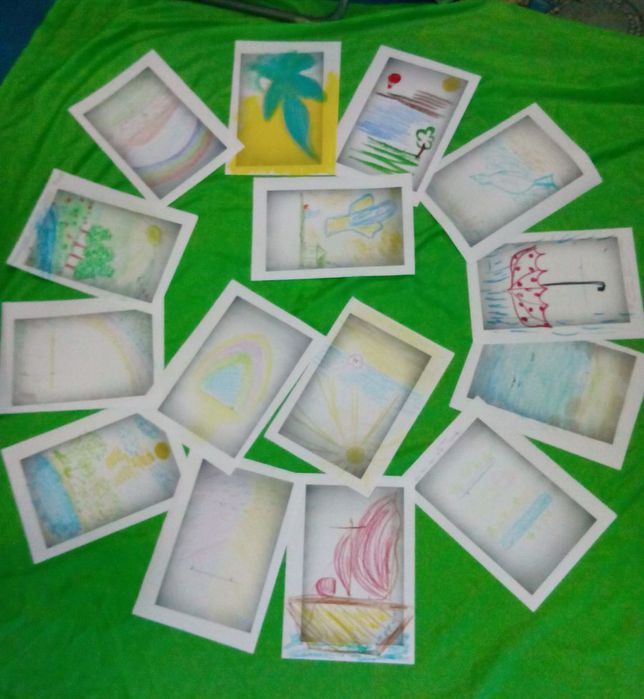
(an example of how a minimalist photo was used to work on filling the image)
Phototherapy technique in psychological counseling
Phototherapy uses the patient’s personal and family photographs along with accompanying memories, thoughts, feelings, and information as a catalyst for therapeutic communication.
The hidden life of private personal and family photos
Each personal picture becomes for a person a kind of self-portrait, a “mirror of memory” in which forever fixed moments of the past are reflected. Taken together, these photographs become both visual traces of past events (both physical and emotional) and indicators of a possible future. Even people’s reactions to postcards, magazine illustrations, and photographs taken by others often reveal the secrets of their personal lives.
The value of any photograph lies not so much in its visual content, but in the emotional and reconstructive reaction of the viewer. Looking at a photograph, people give it a meaning that is not necessarily the same as the photographer’s original intent.
The meaning and emotional content of a photograph depends on the viewer, because the individual characteristics of human perception and purely personal experience automatically shape and determine what a person considers real. Therefore, the reaction of people to photographs of interest to them makes it possible to learn a lot about themselves, if only they are asked the right questions.
How therapists use photography to help people
Many people don’t think about why they keep photos. Photographs always tell stories, regardless of their artistic value (which they may also have), but each photo tells a story in a different way depending on who unconsciously gives meaning to it in the process of being explored.
This makes conventional snapshots not only excellent natural catalysts for social communication, but also a useful tool in situations where verbal communication is not effective enough (eg in therapy). The moments captured in the pictures are so ordinary that people rarely think about what is happening when they try to make sense of what they saw. This not only demonstrates the strong influence of ordinary “non-artistic” photography on most people’s lives, but also explains why photography is so different from other types of media artistic expression, especially when used for therapeutic (or self-knowledge) purposes.
Under the guidance of a phototherapy specialist, clients learn the value of personal pictures and family albums, their emotional component in addition to the visual one. Such information is hidden in the personal photos of the client, but if it can be used to focus the therapeutic dialogue, then there is usually a more or less visible connection with the subconscious.
A phototherapy session includes not only the process of passive study of photographs, but also the process of their active creation, presentation, discussion, listening, reconstruction in order to create or illustrate new narratives collected at the meeting, restored in memory or imagination, integrated into art therapy statements. or even included in a lively dialogue with other photographs.
What Techniques Are Included in Phototherapy?
Taking photographs, or participating in a phototherapy session, is only the beginning – once the photograph can be viewed, the next step is to activate memories (exploring its visual messages, engaging in dialogues, asking questions, considering the results of alleged changes or different points of view, etc. .). What becomes the “destination” for the photographer (final photo) marks the beginning for the phototherapist…
The main task of the therapist is to encourage and support the client’s personal discoveries by exploring and interacting with the usual personal and family pictures they show, take, collect (such as postcards, magazine photos, greeting cards, etc.), remember, actively restore , or even just imagine. Therefore, each of the five methods of Phototherapy is associated with one of the following five types of photography, and they are often used in various combinations with each other, as well as with other art therapy and artistic techniques:
Photos found or created by the client with a camera, a collection of images of people in magazines, the Internet, on postcards, and so on,
Photographs of the client taken by other people, where the client specifically poses, or snapshots taken spontaneously,
Self-portraits are any photographs of oneself taken by the client, where the client is literally or metaphorically in complete control of the process of taking the picture,
Family albums and other biographical photo collections – photographs of the client’s family or family snapshots of choice, stored in albums or more loosely organized into narratives – photographs on walls or refrigerator doors, in wallets or desktop photo frames, on a computer or on family websites. All these photographs are collected to document the client’s personal life narrative and past, and unlike individual photographs, these albums have a life of their own,
The technique of “photo-projections”, which proceeds from the phenomenological fact that the meaning of the picture is mainly formed by the viewer in the process of perception. Any photograph taken by a person evokes reactions that are projected from his or her internal map of reality, determining how people give meaning to what they see. Therefore, this technique is not associated with a particular type of photography, but focuses on the less tangible boundary between the photograph and the viewer (or author), the “area” within which each person forms his own, unique reaction to what he sees.
Phototherapy – Enlarged Image
As explained in the book Phototherapy Techniques – Exploring the Secrets of Personal Snapshots and Family Albums, phototherapy is best viewed as an interconnected system of photography-based counseling techniques. The system is used by trained psychotherapists as part of their psychotherapeutic practice to better understand and explore the lives of clients, helping them to consciously know themselves and subsequently engage in self-discovery through photography.
Therefore, it is not the same as Therapeutic Photography (sometimes also referred to as “Phototherapy”, especially in the UK), which is an activity in its own right outside of any official context. People use “therapeutic photography” for personal self-disclosure or artistic self-assertion, while therapists use phototherapy to help people (their clients) who need help with their problems.
And although the results of photography-based self-exploration (photography-as-therapy) are often “therapeutic” in nature, especially when using the camera as an agent for personal and social change, it is not the same as activation and processes of such experience under the supervision of a professional (photo-in-therapy).
Since phototherapy is used as a set of interrelated flexible methods rather than a fixed theoretical model or therapeutic paradigm, it can be used by any trained counselor or therapist, regardless of their conceptual direction or preferred professional method. This is one of the similarities between phototherapy and art therapy, but also a difference between phototherapy and the reason why it can be used successfully by many psychotherapists not specifically trained in art therapy.
Since phototherapy is more of a photography-communication than a photography-art, no prior experience with a camera or knowledge of the art of photography is required for effective therapy.
Finally, because phototherapy involves people interacting with their unique visual constructs of reality (using photography as an activating verb rather than a passive/reflexive noun), these techniques can be particularly successful with people whose verbal activity is physically or mentally limited. socio-culturally marginalized, or does not correspond to the situation due to the difference in the perception of non-verbal signs.
Therefore, phototherapy can be particularly useful and usually very effective in working with multicultural populations, people with disabilities, sexual minorities, people with special needs, and other groups, as well as useful in training on cultural diversity, conflict resolution, divorce counseling families. and in other areas phototherapy training course for psychologists
Articles on the history, fundamentals, applications, and various forms of art therapy can be found here.
Only the best offers, interesting company news, useful innovations and no spam!