


Art therapy
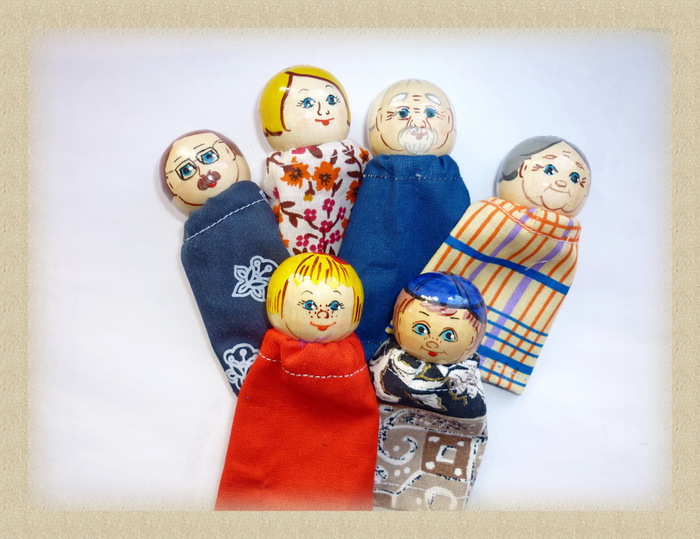
Have you already played with dolls with your baby, or maybe you have already visited the puppet theater? If you have visited a puppet theater or seen a puppet show, for example, in the Regional Rehabilitation Center, you have watched how sincerely a kid laughs at the funny tricks of the heroes. There is nothing surprising. The doll in the eyes of the baby is real, alive. The child often tries to animate the toy. And if she also moves, sings, dances, talks, then she can captivate him for a long time. And often it is the doll that will explain to the child what you cannot explain to your son or daughter.
You can, of course, become only a consumer, that is, come to a finished performance and watch it. And you can become the creator of a puppet show. In child psychology, there is a whole direction – puppet therapy. Putting a doll on his hand, the baby seems to merge with it, through it he experiences various life situations, can cope with his fears, throw out negative emotions, or, conversely, share his joy.
By creating a home puppet theater, you and your child will try out many roles: you will prepare various puppets, draw scenery, write a script for a future masterpiece, figure out how to arrange a stage, think over musical accompaniment and the crown of everything: a performance. Just imagine how much imagination, creativity, self-confidence this activity will require from a child. And also the training of fine motor skills of the hands, the development of speech, artistic taste and imagination, the knowledge of new and interesting things, the joy of working together with loved ones, pride in one’s success, and this list goes on.
Creating a home puppet theater is such a developing and multifaceted activity that you should not spare time and effort for this.
Start your home theater business by choosing a script. This is determined by the age of the child. The younger he is, the simpler your performance should be. Folk and author’s fairy tales will be ideal. There are three options for choosing a scenario: the first – you can take the finished text of a fairy tale and play it word for word; the second option is to slightly change the fairy tale (for example, add funny episodes, remake the ending of a well-known fairy tale, introduce new characters); and the third is to invent and act out your own story. In this case, the opinion and interests of the child must be taken into account. Maybe your kid already likes some fairy tale story? Then it is worth starting the work of a home puppet theater with her. In Appendix 3 we offer you several scenarios based on famous fairy tales.
When the script is ready, think about what kind of puppets you will need. Often one doll can participate in many performances if you put different clothes on it. Thus, the girl doll will be Little Red Riding Hood, Cinderella, and Masha from the Three Bears. You just need to change her hairstyle, outfit, headdress. The secondary characters don’t have to be glove puppets. You can use ready-made soft toys or make your own dolls. What dolls are and how to make them is described in the Appendix.
Now let’s start making the scenery and decorating the stage. For the simplest performance, where there are no special scenery, you can simply pull a rope across the room, and hang a large piece of fabric on it. The screen is ready! If desired, you can decorate it with flowers cut out of paper, butterflies, children’s drawings or something else – it depends on the theme of the performance. If you like to sew, then a screen sewn from various shreds will look very original. If you decide on decorations and the child is eager to help you, then the screen is treated differently. If you need a forest or a house according to the scenario, then you can put a wide board on the backs of two chairs and drape it all with a cloth. Now you can put all the necessary decorations on top of the board. You can make them from thick cardboard or plywood if dad helps you. It is desirable that the decorations are multifunctional. So, for example, a house can be painted both outside and inside: outside you have a palisade, a window, and a room is drawn inside. At a certain height from the screen, you can stretch a thread and hang cardboard sun, clouds, clouds, rainbows, stars on it according to your scenario.
After all the preparations are made, you can proceed directly to the rehearsals. In the process of rehearsals, select the musical accompaniment for the performance. This will make it even brighter and more unusual. To do this, you need to: write down all the sound fragments that suit you on a cassette or disk in order. Then ask someone (dad, older children) to act as a sound engineer and play the right pieces of music at the right time. Decide with your child who will play which roles. At the same time, keep in mind that you can control two dolls at once, but for the first time, the baby should be entrusted with only one. If you have a small child, then complicate the task gradually. For starters – simple roles, where there are few words and actions, and when the child is comfortable with the doll, offer him a more complex role.
And most importantly: remember that your goal is not a perfectly staged performance, but the pleasure and joy that it brings to young artists and spectators. Teach your child to improvise if something goes wrong during the show.
Now you are all set for the premiere. You can issue invitation cards for your performance and distribute them to grandparents, godparents, friends of the child. It is important that the premiere leave positive and joyful experiences in the soul of the baby. It is worth thinking about the sweet table after the premiere. Flowers presented to the debutant and thunderous applause from close people will be the key to further productions. Maybe you will show the next performance in the kindergarten where the child goes. And it is very likely that other parents with children will join your small troupe, forming a real creative team …
Puppet workshop
The origin of toys (dolls) is associated with the religion of ancient peoples who believed that toy figures have magical powers that can protect a child from evil, bring him health and happiness. People have long believed that the doll has a mysterious mystical power and supernatural abilities. They used puppets in rites of exorcism. For example, in Japan there is a well-known rite, during which the illnesses of its sick owner are “dumped” onto the doll. After that, the doll is put into a paper boat and set sail. Over time, the boat gets wet, and the doll, along with all human diseases, sinks. There are similar rituals among the peoples of Russia. There is a legend that one winter in a peasant family living in a forest hut, a child fell ill. The boy faded away and kept asking when summer would come. The father, in order to alleviate the suffering of his son, carved birds from pine trees and hung them around the hut. The son saw them, asked for food and began to recover.
Toys also entertained, pampered children, helped them to know themselves and the world around them, to develop spiritually and physically.
Little has changed over the centuries, only the materials have changed, with the help of which the master gives the doll individuality. Parts of the face purchased or made independently, synthetic hair, movable fasteners make it possible to create a wide variety of designs for toys and dolls. Toys can be made from different materials, different types: three-dimensional, planar, finger, glove, paper, improvised and natural materials. A doll toy can be made to ring, crackle, whistle, buzz, speak and sing in different voices.
Types of dolls are varied:
1. Plane dolls – their basis is cardboard, on the back of which a loop is sewn so that it can be manipulated, decorated on top with cloth, paper, beads.
2. Semi-volumetric – they are made in the same way as planar according to the pattern, only a soft pad is made between the base (cardboard and material), which gives the toy volume.
3. Volumetric – made of several parts, each stuffed with cotton wool, foam rubber, synthetic winterizer, then fastened together.
4. Frame dolls – use soft wire (section 1-2 mm) and fabric, the frame is made in relation to the size of the toy. The figures of animals and people, thanks to the flexibility of the frame, can change poses and take different positions.
5. Paper dolls – artistic design from different textures of paper (thin, thick, corrugated, velvet, napkin) with the help of color and shape helps to create images, convey character, mood. Figures are made using different design techniques (from a cylinder, a cone, a rectangle, a circle, a square …). Such puppets are good in shadow, tabletop theater and flannelography.
6. Doll “Bibabo” (glove) – the head of the doll – a ball (diameter 10 cm), stuffed with material. After stuffing, they are not tightened tightly, a tube is inserted (the tube is glued from cardboard or thick paper, the diameter should correspond to the child’s index finger). Thus, the head is obtained on a movable neck. Instead of doll clothes, they use a glove or sew a dressing gown according to a pattern.
7. A puppet doll is a doll that moves with the help of strings tied to its arms and legs. Rollers are sewn for legs, arms, neck, torso, depending on the role of the doll. Sticks-beams or pencils are connected crosswise, a strong thread or fishing line is tied to the limbs to manipulate the doll. The puppeteer, pulling the strings in turn, makes the puppet come to life.
8. Dolls from mittens and gloves – made from old mittens and gloves. Buttons, buckles, ribbons, felt are sewn on them so that eyes, mouth, eyebrows are obtained. The nose forms the thumb of the mitten, and the head is its main part. From the movement of the hand, the eyes move, the mouth, nose and face of the doll comes to life.
9. The muppet doll consists of two main parts – the head and the torso. For the head, you need a ball of such a size that the puppeteer’s hand fits in it. A big mouth is made for the doll – the ball is cut to half, and an oval piece of cardboard is sewn into the resulting cut (this part is glued with the same material from which the whole doll is sewn, the workpiece is folded in half and placed under the press, and then glued into the slots of the ball with a fold inward) . The robe is sewn in such a size that gloves can be placed at the ends of the sleeves. One glove is attached to the belt, the other serves to control the doll. The doll is made according to the conceived character.
All of the above types of puppets can be used both in puppet therapy classes conducted by specialists and at entertainment events, as well as in home theater.
A toy made by a child with the help of an adult is not only the result of labor, but also a creative expression of his individuality. Children learn to plan their activities, use different tools, select the necessary material, take a responsible approach to work, and develop taste. A doll that has passed through the hands of a child becomes especially attractive. The thing on which he worked, putting fiction, fantasy and love into it, comes to life in his hands, bringing joy to the child and others. Thus, the work on the manufacture of doll toys is a creative activity and meets the objectives of the artistic and labor education of children.
Literature
1. Agapova I.A., Davydova M.A. Do-it-yourself soft toy – M .: Rolf, 2001.
2. Nagibina M.I. Fabric wonders with your own hands. A popular guide for parents and educators – Yaroslavl: Academy of Development: Academy, K °: Academy Holding, 2000.
3. Novikova I.V., Bazulina L.V. 100 crafts made from natural materials – Yaroslavl: Academy of Development: Academy, K °: Academy Holding, 2001.
4. Stolyarova A.M. Pillow toys – M .: Publishing House “Culture and Traditions”, 2003.
Articles on the history, fundamentals, applications, and various forms of art therapy can be found here.
Only the best offers, interesting company news, useful innovations and no spam!