


Art therapy
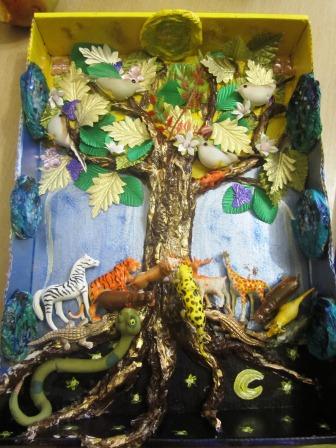
An example of designing a myth for a school project. The myth about the World Tree (arbor mundi, “cosmic” tree), an image characteristic of mythopoetic consciousness, embodying the universal concept of the world. The image of the World Tree is attested almost everywhere, either in its pure form, or in variants (often with an emphasis on one or another particular function) – “tree of life”, “tree of fertility”, “tree of the center”, “tree of ascension”, “heavenly tree”, “shaman tree”, “mystical tree”, “tree of knowledge”, etc.; more rare options: “tree of death”, “tree of evil”, “tree of the underworld (lower world)”, “tree of descent”. With the help of the World Tree in all its variety of cultural and historical variants [including its transformations or isofunctional images such as “axis of the world” (axis mundi), “world pillar”, “world mountain”, “world man” (“first man”) , temple, triumphal arch, column, obelisk, throne, ladder, cross, chain, etc.] bring together the general binary semantic oppositions that serve to describe the main parameters of the world. The image of the World Tree is revealed or reconstructed on the basis of mythological, in particular cosmological representations recorded in verbal texts of various genres, monuments of fine arts (painting, ornament, sculpture, glyptics, embroidery, etc.), architectural structures (primarily religious), utensils in the broad sense of the word, ritual actions, etc. Directly or indirectly, the image of the World Tree is restored for various traditions ranging from the Bronze Age (in Europe and the Middle East) to the present [cf. autochthonous Siberian, American (Indian), African, Australian traditions].
The image of the World Tree played a special organizing role in relation to specific mythological systems, determining their internal structure and all their main parameters. This role is clearly seen when compared with what preceded the “epoch of the World Tree” in the form in which this stage was imagined by people of the subsequent era. We are talking about fairly standard descriptions of unsigned and unsigned chaos, opposed to the sign-organized cosmos. Cosmogonic myths describe the formation of the world as a result of the consistent introduction of the main binary semantic oppositions (heaven – earth, etc.) and gradual series such as plants – animals – people, etc. and creating a cosmic support in the form of the World Tree or its equivalents. In contrast to this, the earliest sign systems created by man and restored according to the most ancient sources dating back to the Upper Paleolithic (rock painting, etc.) do not reveal any distinct traces of oppositions with a local-temporal meaning, and the very image of the World Tree not present in these systems. The world tree is placed in the sacred center of the world (the center can be differentiated – two world trees, three world mountains, etc.) and occupies a vertical position. It is the dominant that determines the formal and meaningful organization of the universe space. When dividing the World Tree vertically, the lower (roots), middle (trunk) and upper (branches) parts are distinguished. Vertically, oppositions are found [up-down, sky-earth, earth-underworld, fire (dry) – moisture (wet) and others], identifying mythological characters and the world in which they operate with sufficient completeness and accuracy. With the help of the World Tree, the following are distinguishable: the main zones of the universe are the upper (heavenly kingdom), middle (earth), lower (underground kingdom) (spatial sphere); past – present – future (day – night, favorable – unfavorable season), in particular in the genealogical refraction: ancestors – current generation – descendants (time sphere); cause and effect: favorable, neutral, unfavorable (etiological sphere); three parts of the body: head, torso, legs (anatomical sphere); three types of elemental elements: fire, earth, water (the “elemental” sphere), etc. Thus, each part of the World Tree is determined by a special bundle of signs.
The trinity of the World Tree along the vertical is emphasized by the assignment to each part of a special class of creatures, most often animals (occasionally classes of deities or other mythologized characters). Birds are associated with the upper part of the World Tree (branches) (often two – symmetrically or one – at the top, often – an eagle); with the middle part (trunk) – ungulates (deer, elk, cows, horses, antelopes, etc.), occasionally bees, in later traditions and humans; with the lower part (roots) – snakes, frogs, mice, beavers, otters, fish, sometimes a bear or fantastic monsters of the chthonic type. Wed description of the huluppu tree in the Sumerian version of the Epic of Gilgamesh: in the roots – a snake, in the branches – the bird Anzud, in the middle – the maiden Lilith. In the plot of the so-called. of the main Indo-European myth, the vertical structure of the World Tree is also played up: the thunder god, located on the top of the tree (or mountain), strikes the snake at the roots of the tree and frees the cattle stolen by the snake, wealth (the middle part of the tree). The Egyptian sun god Ra (in the form of a cat) strikes a snake under a sycamore tree. The hero of fairy tales is saved from the dragon by climbing the World Tree, and the eagle carries the hero out of the lower world.
A number of facts indicate that the image of the World Tree is correlated with the general model of marital relations and, more broadly, with the succession of generations, the genealogy of the genus as a whole (cf. “mythological” genealogical trees). Among the Nanais, family trees – their images are traditional on women’s wedding gowns – were associated with ideas about the fertility of women and about procreation. Such trees grew in the sky in the domain of the female spirit. Each clan had its own special tree, in the branches of which the souls of people bred, then descended in the form of birds to the ground to enter the womb of a woman from this clan. The upper part of the Nanai robe reproduces the scales of a dragon, and two dragons are depicted on the back of the robe – a male and a female. Thus, all three tiers of the World Tree – top, trunk and roots – and the three classes of animals associated with them in their own way reflect the idea of conception and fertility. There are also inverted images of the World Tree. Here are typical descriptions of such a World Tree: “From the sky the root stretches down, from the earth it stretches up” (“Atha rva veda”) or: “At the top is the root, below the branch, this is the eternal fig tree” (“Katha-u Panishada”), or in a Russian conspiracy: “At the sea on the Ocean, on an island on Kurgan, there is a white birch, branches down, roots up.” Such inverted trees are depicted in the appropriate traditions on ritual objects. Often natural inverted trees are also used in the ritual [for example, among the Evenki, two rows of trees were placed on the sides of the shamanic tent, symbolizing the middle world, the earth – branches up (the tree of the lower world), branches down (the tree of the upper world)]. It is possible that the image of an “inverted” tree arose precisely in connection with the geometry of the lower world, in which all relations are “inverted” compared to the upper and middle worlds (the living becomes dead, the visible becomes invisible, etc.; see Art. Afterworld). It is characteristic that during the so-called. “shamanic journeys” a shaman returning from heaven to earth sees first the branches, and then the trunk and. roots, i.e. the same “inverted” tree. Thus, the “inversion” is explained either by the peculiarities of the metric of the space-time continuum of the universe, or by changes in the position of the observer. The image of an “inverted” tree often appears in later eras in the individual mystical consciousness, in painting and poetry.
The horizontal structure of the World Tree is formed by the tree itself and the objects on either side of it. Most clearly, it is found in connection with the trunk. Usually, on both sides of the trunk there are most often symmetrical images of hoofed and (or) human figures (gods, mythological characters, saints, priests, people), cf. typical Aztec images of the World Tree., where the solar god is to the right of it, and the god of death to the left, or scenes of sacrifice in the Ancient Mesopotamia, etc. Such compositions appear quite transparently at a later time in the works of Christian and Buddhist art. If the vertical structure of the World Tree is connected with the sphere of the mythological, primarily cosmological, then the horizontal structure is correlated with the ritual and its participants. The object of the ritual or its image (for example, in the form of a sacrificial animal – a cow, a deer, an elk, etc., and earlier a person combined with a tree) is always in the center, the participants in the ritual are on the right and left. The entire sequence of elements horizontally is perceived as a scene of a ritual, the main purpose of which is to ensure prosperity, fertility, offspring, wealth. The ritual itself can be interpreted as a pragmatic realization of the myth, a projection of the “mythological” into the sphere of the “ritual”. Since the horizontal structure of the World Tree models the ritual, it conveys not only the sacrificial object, but also the subject that perceives this object, which in principle can be identical to it [cf. numerous images of a deity on a tree, cross, pillar, etc. (test of Odin on the ash Yggdrasil in Scandinavian mythology, a bloody sacrifice on a tree among the Celts, Jesus Christ, etc.) or descriptions of a person as a tree]. A significant number of facts make it possible to reconstruct two horizontal axes in the scheme of the World Tree, that is, a horizontal plane (square or circle, cf. mandala), defined by two coordinates – from left to right and from front to back. In the case of a square, each of the four sides (or corners) indicates directions (cardinal points). On the sides or corners there can be located in the center Correlative with the main World Tree Partial world trees ^ or mythological characters, personifications of the cardinal points, in particular winds [cf. “Eddu” or “four” gods, for example, among the Aztecs: the god of the east (red), the god of the north (black), the god of the west (“feathered serpent”, white), the god of the midday sun (blue), the “four Perkunases” and four-faced deities, cf. Zbruch idol]. Ideas about this scheme can be given by the Aztec images of the World Tree, inscribed in a square, shamanic tambourines among the Laplanders and other northern peoples, the mythologized structure of a city or country (for example, in ancient China), etc.
The same scheme of the World Tree is constantly repeated in ritual formulas; cf .: “I went out, on four sides, I made a sacrifice” (“The Tale of Gilgamesh”) or “On the sea on the Ocean, on the island of Buyan, there is an oak tree … under that rune of a swift snake … And we will pray to you, on all four sides bow”; “… there is a cypress tree …; call in and get it from all four sides from the drain and the west, and from the summer and the north: go from all four sides … as the sun and the moon go, and frequent small stars ”; “By this ocean-sea stands a carcolist tree; hanging on this tree are: Kozma and Demyan, Luka and Pavel ”(Russian conspiracies). The same four-part scheme, as is known, underlies religious buildings that retain the semantics of their elements (cf. pyramid, ziggurat, pagoda, stupa, church, shamanic tent, menhirs, dolmens, cromlechs, etc.), in particular, the orientation along countries of the world. Wed the plan of the Mexican pyramid of Tenochtitlan: a square divided into four parts by diagonals, in the center – a cactus with an eagle devouring a snake; the structure of the altar, through which the axis of the world passes, marking the sacred center. In many cases, each marked element of the horizontal structure is distinguished by a special D. m., hence the wide distribution of eightfold objects (cf., for example, eight trees connected in pairs and eight creatures; the image of the world in the form of an eight-legged elk among the Orochs in the Far East; eight branches of the tree in front of the dwelling of the deity and the octagonal earth in the Yakut mythological texts, the eight deities of the Ptahs in the ancient Egyptian Memphis version of the creation myth, etc.). The horizontal structure of the scheme of the World Trees models not only numerical relations (see Numbers) and the cardinal points, but also the seasons (spring, summer, autumn, winter), parts of the day (morning, afternoon, evening, night), colors, elements of the world. The horizontal structure makes it possible to distinguish between the mastered (associated with culture) and the undeveloped (associated with nature). The World Tree itself, in a certain sense and in certain contexts, becomes a model of culture as a whole, a kind of “tree of civilization” in the midst of natural chaos.
The world tree separates the cosmic world from the chaotic world, introducing into the first of them a measure, organization and making it available for expression in the sign systems of texts. In particular, it is the D. m. scheme that contains a set of “mythopoetic” numerical constants that order the cosmic world: three (vertical divisions, triads of gods, three heroes of a fairy tale, three highest values, three social groups, three attempts, three stages of any process etc.) as an image of some absolute perfection, any dynamic process that involves the emergence, development and completion; four (horizontal divisions, tetrads of gods, four countries of the world, main directions, seasons, space ages, elements of the world, etc.) as an image of the idea of static integrity; seven as the sum of the two previous constants and an image of the synthesis of the static and dynamic aspects of the universe (cf. the seven-membered structure of the universe among the Zuni Indians; seven branches of the World Tree, shamanic trees, seven-membered pantheons, etc.); twelve as a number describing the World Tree (“There is an oak, there are 12 branches on the oak …” or “There is a pillar to heaven, there are 12 nests on it …” in Russian riddles) as an image of fullness.
In archaic traditions, there are diverse texts that are directly or indirectly related to the World Tree and allow clarifying its ritual and mythological meanings. First of all, such texts describe the main sacred value – the World Tree itself, its appearance, its parts, attributes, connections, etc. In these texts, the World Tree is depicted statically and, as a rule, in isolation from the needs of the human team. However, there are texts of a different kind: they describe the World Tree in its functional aspect. As a rule, texts of this kind are timed to coincide with the situation of the main annual holiday, marking the transition from the old year to the new one. It is in this situation that the global determinism inherent in the mythopoetic worldview, which comes from the identity of the macro- and microcosm, nature and man, manifests itself with special consistency. The highest value (the maximum of sacredness) is possessed by that point in space and time where and when the act of creation took place, i.e. middle
world, where the World Tree stands, and “in the beginning” – the time of creation (see Mythical Time). In terms of time, the situation “at the beginning” is repeated during the holiday, when the sun at the junction of the old and new years describes its annual path around the World Tree. The holiday precisely reproduces with its structure the frontier situation, when the forces of the cosmos that have fallen into decay are opposed by the forces of chaos that have gained strength. A fatal duel takes place, like “at the beginning”, ending with the victory of cosmic forces and the re-creation of a new (but modeled after the old) world.
The festive ritual imitates these stages of creation. It begins with the “reversal” of the entire system of oppositions (the king becomes a slave, the slave becomes the king, the rich becomes the poor, the poor becomes rich, the top becomes the bottom, etc.) and ends with its restoration in the previous arrangement. On the basis of cosmogonic texts, it is possible, apparently, to hypothetically restore the entire ritual scheme dedicated to the World Tree 1) starting position – the junction of the old and new years, the world fell apart in chaos; the task of the ritual is to integrate the cosmos from the constituent parts of the victim, knowing the rules of identification given by mytho-poetic classifications; 2) the priest pronounces the text containing these identifications over the victim near the sacrificial pillar or other image of the D. m., marking the sacred center of the world; 3) riddles about the elements of the cosmos in the order of their occurrence and answers to them; 4) appeal to the World Tree as an image of the newly recreated cosmos. The actual mythological aspect is associated with the presence of all the gods, the duel between them (or the main one among them) and their opponent (the monster), the distribution of spheres and functions in the organizing world between individual gods, mythological motives of an etiological nature (“how was the sky created?”; “ Why is it dark at night?”; “Where did the stones come from?”, etc.).
The special role of the World Tree for the mythopoetic era is determined, in particular, by the fact that the World Tree acts as an intermediate link between the universe (macrocosm) and man (microcosm) and is the place of their intersection. The image of the World Tree guaranteed a holistic view of the world, the determination by man of his place in the universe.
In the cultural development of mankind, the concept of the World Tree left its traces in numerous cosmological, religious and mythological representations reflected in the language, in verbal texts of various kinds, in poetic images, in fine arts, architecture, settlement planning, in ritual, games, choreography, in social and economic structures, perhaps in a number of features of the human psyche (cf., in particular, the special “Koch test” in psychology, which reveals that at a certain stage in the development of the child’s psyche, the image of a tree dominates in the images created by children). In the Middle Ages, the World Tree diagram was widely used as a means of illustrating a whole consisting of many elements hierarchized in several planes [cf. “genealogical (genealogical) tree”, “alchemical tree”, “tree of love” (its image is given in one Provençal poem by Matfra Ermengau, 13th century), “tree of the soul”, “tree of the life path”, etc.]. The latest versions of such schemes are widely used in modern science (linguistics, mathematics, cybernetics, chemistry, economics, sociology, etc.), i.e. where the processes of “branching” from a single “center” are considered. Many schemes of control, subordination, dependencies, etc., currently used, go back to the scheme of the World Tree (cf. the image of the structure of power, social relations, the composition of the parts that form the state, control systems, etc.).
The roots of the World Tree wash the waters of the underworld, its trunk, soaring into the sky, wraps around the Serpent – a symbol of the earth’s energy moving in a spiral, and the crown pierces outer space. The World Tree grows either in paradise or on a sacred mountain (each nation has its own, as well as ideas about the type of tree). Among the Sumerians, cedar acts as the World Tree, among the Phoenicians – cypress, among the Arabs – a palm tree, among the Scandinavians – ash, among the Slavs – oak. For the peoples of Eastern Europe, the Tree of Life is a birch, for the peoples of Siberia it is a larch, and for some tribes of South America it is a bamboo. In the Tibetan tradition, preference is given to the willow, in the Islamic tradition, to the olive, and so on.
In most cases, the Tree of Life bears fruit, and its fruits bestow immortality. Most often, these fruits have real analogues (peaches – among the Chinese, figs – among the Hindus, apples – among the ancient Jews), but sometimes the fruits themselves become the fruit of human imagination, as can be seen, for example, from the myths about the jambu – the Mongolian Tree life. The very name, “jambu”, allegedly came from the sound with which the ripened fruits fall into the mythical Mapa-mu sea, which washes the sacred mountain of Jam-budvipa, where the tree grows.
The World Tree of the Slavs, similar to a huge sprawling oak, links together the inhabited world of people, the underground World of the Dead and nine heavens. On a wonderful oak, the seeds of all existing trees and herbs ripen, and in the seventh heaven, on a magical island, the progenitors of all animals and birds live.
The World Tree of the Scandinavians, the giant ash tree Yggdrasil, connecting nine worlds, is very colorfully described in the Elder Edda. The evergreen Tree of Life is saturated with sacred life-giving honey. On its top sit an old wise eagle and a hawk Vedrfelnir (“faded from the weather”), and a dragon and snakes gnaw at the roots of the tree. The squirrel Ratatosk (“rodub”) runs along the trunk, a kind of intermediary between them. Standing on the roof of Valhalla, the wonderful palace of Odin, the deer Eikturmir and the goat Heidrun nibble on ash leaves. Three roots of Yggdrasil extend to the world of people, giants and the Kingdom of the Dead. Under the roots of the wonderful ash tree are three sources: Urd (“Fate”), Hvergelmir (“Boiling Cauldron”) and the honey source of Mimir’s wisdom. At the source of Urda live the norns, the goddesses of fate. They take care of the tree, water it from the source so that the ash, gnawed by snakes, does not dry out. Next to Yggdrasil rises the main sanctuary, where the gods make their judgment. Source of the description about the tree http://myfhology.info
Articles on the history, fundamentals, applications, and various forms of art therapy can be found here.
Only the best offers, interesting company news, useful innovations and no spam!