


Art therapy
Time: 35-45 min.
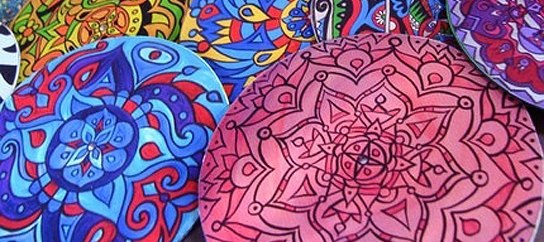
For this technique, the circle was chosen as a mythological symbol of harmonies. It is believed that the circle, due to the absence of sharp corners, is the most “friendly” of all geometric shapes, meaning approval, friendship, sympathy, gentleness, sensuality. Working in a circle activates integrative, emotional, intuitive (right hemisphere) thinking, and also unites, stabilizes the group, and contributes to the formation of favorable interpersonal relationships. Even small children, according to Sh. Rais, prefer circles to all other figures. This is apparently due to the simplicity of the round shape. The artist, as E. Bulow in the article “And here is a sign for you …”, immersed in the process of depicting a wide variety of symbols, fills the entire surface of the sheet to the very edge, as if opening them for himself. Many sheets, dotted with circles, sometimes larger, sometimes smaller, touching or intersecting with each other, and sometimes included in one another, raise the question of the significance of the circle as a symbol. Usually, drawn circles are far from perfect in terms of geometry. However, they are self-sufficient entities, for the designation of which it is difficult to find words. In the mind, only ideas about a certain form arise, the aesthetic merits of which hold attention.
Purpose: development of spontaneity, reflection; allows you to clarify personal characteristics, values, claims, the nature of the problems of each participant, his position in the group; reveals interpersonal and group relationships, their dynamics, has the potential for the formation of group cohesion.
Materials: Two rolls (one for each table) of thick paper. A variety of visual materials and tools in sufficient quantities: pencils, felt-tip pens, paints, gouache, brushes, jars of water, eraser, adhesive tape.
Course of the exercise: The group sits around the table, they are offered whatman paper, simple pencils, paints, brushes, glossy magazines and glue. Each of the participants draws a circle figure, and can also draw other people’s drawings, write wishes to each other. At the end of the work, the participants share their impressions of the joint work, show their own drawings, talk about the idea, plot, feelings, read out, if desired, aloud the good wishes that other participants wrote to him.
Instructions: Take a seat at one of the tables. You can change your location if you wish. You have the right to move freely around the table and work in any territory. Draw a circle of the desired size with the color you like. Then draw one or two more circles of any size and color on the sheet. Outline the drawings. Connect your circles with lines that you especially like. Imagine that you are laying roads. Fill the space of each of your circles with story drawings, icons, symbols, i.e. give them personality. Next, walk around the picture sheet, carefully examine the drawings. If you really want to finish something in the circles of other participants, try to negotiate with them. With the consent of the authors, write kind words and wishes about the drawings that you like. Be careful of space and the feelings of others! Sketch the remaining free space on the sheet with patterns, symbols, icons, and more. First of all, agree with other participants on the content and methods of creating a background for the collective drawing.
Issues for discussion:
“How are you feeling?”
“How are you feeling now?”
“Tell me about your drawing?”
“Did you complement the work of other participants?”
What difficulties did you encounter along the way? and etc.
Articles on the history, fundamentals, applications, and various forms of art therapy can be found here.
Only the best offers, interesting company news, useful innovations and no spam!