


Art therapy
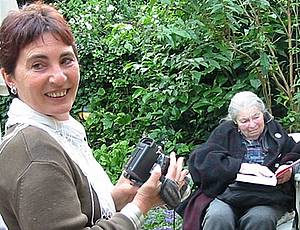
Elena Makarova
Art heals, but for this you need to become a creator
Author: Sergey Makarov
Elena Makarova and Edith Kramer
When creative impulses are suppressed by indifferent adults, the child withdraws into himself, loses the feeling of flight. Hence autism, fears, aggression and other sore features of child development. If you manage to involve a person in the creative process, many psychological barriers disappear – both for children and parents. It turns out that creativity and freedom are indispensable components of a healthy personality.
Bauhaus – liberation through rhythm and line
The activity of Makarova as a teacher is closely connected with the system of the Bauhaus school (1919-1933), its teachers I. Itten, V. Kandinsky, P. Klee and others. Elena Makarova has been studying the life and work of one of the graduates of the Bauhaus, the artist Friedl Dicker-Brandeis, for many years.
“The pursuit of art is not meant to make everyone an artist,” wrote Friedl Dicker. “Their task is to release such sources of energy as creativity and independence, to awaken fantasy, to strengthen the ability to observe and evaluate reality.”
As for the assignments that are given in classes and seminars, even here Makarova starts with Friedl, more precisely, with the Bauhaus Introductory Course, which I. Itten first conducted in 1919. Friedl taught this course for beginners in 1920 as a student. She later taught the same technique with children and adults in Vienna and Prague, and then in the Terezin concentration camp from the end of 1942 until October 1944, when she was killed in Auschwitz. Her art, letters and 5,000 drawings by her Terezin students remained. In addition, the abstract of the lecture “On the Children’s Drawing”, prepared by her for the teacher’s seminar in the Terezinsky concentration camp in the summer of 1943, has been preserved.
In this technique, the so-called liberating exercises of the Bauhaus school play an important role. They resemble drawings of small children, about 2-3 years old. This similarity is not accidental: the elementary forms and trajectories of lines in space are the basis of fine art. Treatises Kandinsky, Itten and Klee wrote about this.
This is where it all starts. Rhythm, music, movements that form forms in space. After all, in the preparation of musicians, “meaningless” exercises are played for the hands and fingers (or lips, if it is a wind instrument) – when their movement is most natural and free and not yet constrained by the composer’s intention.
At this stage, music and line are one, because they are interconnected by a common rhythm. A child lives in this element. Adults who were dragged out of there by the scruff of their necks return to normal at Makarova’s seminar, so that later they can freely develop creatively. They see with their own eyes how easily a line acquires volume and plasticity, how easily spirals and circles (and then moons, trees and whole pictures) come off the plane of a sheet, how simple and
it is interesting to create volume and translate the drawing into sculpture. And one more important detail: adults are beginning to love art and show children worthwhile paintings, and not any nonsense, now they go to museums with children and comprehend together with them what seemed incomprehensible until recently.
Elena Makarova to her students:
“And today I thought: perhaps Friedl’s soul rejoices. It’s a miracle – after so many years of oblivion, after such a nightmarish death, we are sitting in different countries and learning to breathe along with the line, for me this is such a significant event, you can’t even imagine.
And how does it happen…
To begin with, most parents, and even more so grandparents, were brought up outside of art and in denial of the meaning of art for education, especially for young children. And if they already took on this task, then it turned out one melancholy – either in kindergarten or at school.
Unable to understand and feel what children’s creativity and a creative child are – it is too complicated and incomprehensible for a blinkered adult – educators came up with “developing techniques” aimed at “developing spatial imagination”, “mastering the subject environment” and so on.
In kindergarten, they are still forced to paint mushrooms and cats or cut them out of colored paper and stick them on a sheet. A child’s drawing is considered meaningless if an adult does not understand it. Only those drawings are recognized in which “something” is depicted, and something “normal” at that: a house, trees, a boy, a dog. Modeling is generally considered only an auxiliary means for the development of fine motor skills.
The trouble is that adults cannot understand in any way that a child (like an adult, if he is open) can freely immerse himself in the element of art and master its language. Art for him (as well as for an adult artist) is not a tool, but a means of expressing himself and his attitude to the world. Correlating the image with the depicted, in fact, does not interest him.
But, having felt an adult “order”, a child can give out houses and dogs, so that an adult can recognize them and be touched. Without independent comprehension of the language of art, children break down, and most often this is the beginning of the end of their romance with art. But some – there are more of them! – becoming parents, they understand that they have been broken and that they need to return to creative activity so as not to repeat the mistake of their parents and teachers.
Initially, Elena’s classes were intended for children, but already during the first seminar a surprise awaited her. Mothers have turned from a means of conveying the “message of freedom” to their children into a goal! Children, of course, light up from their mothers – to a greater or lesser extent – but then the mothers themselves burn to the fullest.
Art Therapy: Don’t Conduct!
Elena Makarova has been working in the field of art therapy and art teaching for 30 years, and her audience is growing all the time. Starting her career at the Center for Aesthetic Education in the city of Khimki, she traveled to Moscow clubs and cellars for several years, and then worked with children at the Israel Museum in Jerusalem for seven years. Today, thousands of parents, overwhelmingly mothers, got acquainted with her books “How to fashion a snort”, “Overseas swell” and others.
If we assume that pedagogy is half science and half art, then Makarova is undoubtedly an art teacher. Natural intuition and fantasy, knowledge and experience in art, plus the moral imperative to help the child, plus what is in the teacher from the manager – the ability to ignite and lead – all this led her to the camp of “teachers-healers”, which included Friedl Dicker- Brandeis, Franz Cizek, Paul Klee, Johannes Itten, Edith Kramer and others.
On her teaching path, Elena met both enemies – the Soviet bureaucratic system and, in general, representatives of the “scientific family”, and friends-mentors. Among the latter are such personalities as the famous geneticist Vladimir Pavlovich Efroimson, her chief critic and mentor, who would have turned 100 on November 21 this year, and Friedl’s student Edith Kramer, an artist and world-famous art therapist. She emigrated from Europe to America in 1938 and, in fact, there put Friedl’s ideas into practice.
A few words about art therapy. It has long been known that the perception and occupation of art can be a support and help in solving mental and psychological problems. However, modern clinical art therapy was only born in the 1940s and 1950s. It allows diagnosing the drawings or sculptures of children who are unable to describe their problems verbally, as well as the treatment/rehabilitation of patients, primarily mental ones, using special techniques that include elements of psychoanalysis and psychotherapy.
As an art therapist without a special diploma, Lena Makarova works with children outside the clinic – with autistic children, pedagogically neglected, hyperactive and others, whose life is burdened by various injuries. She writes about this in the book Art Therapy, or How to Overcome Fear.
But back to Makarova, a follower of Friedl Dicker. Already in Elena’s first book on education through art (“Free the Elephant”, 1985), the main guidelines similar to Friedl were outlined: 1) release; 2) do not interfere; 3) do not dictate and “do not orchestrate flashes of children’s insight”; 4) do not require a “finished result”; 5) go from the material in which “everything is” (for example, an elephant is sitting in a piece of plasticine and you need to pull it out of there); 6) deal with each child individually, albeit in a group, and 7) rely on rhythm and music.
Characteristically, neither Friedl nor Elena (unlike Soviet and non-Soviet didacticists) undertake to lead the child. This is the wisdom and fundamental difference between “liberating” pedagogy (can there be any other?). If someone imagines that he controls someone else’s creative process, then he is deeply mistaken: either he controls only his imagination, or what he controls is not a creative process. The soul of the artist is autonomous, and interference can only spoil the matter, especially if it concerns a child whose ego has not yet formed, and the temptation to receive praise from an adult is great.
http://www.mydetstvo.com/
Articles on the history, fundamentals, applications, and various forms of art therapy can be found here.
Only the best offers, interesting company news, useful innovations and no spam!