


Art therapy / Psychological drawing
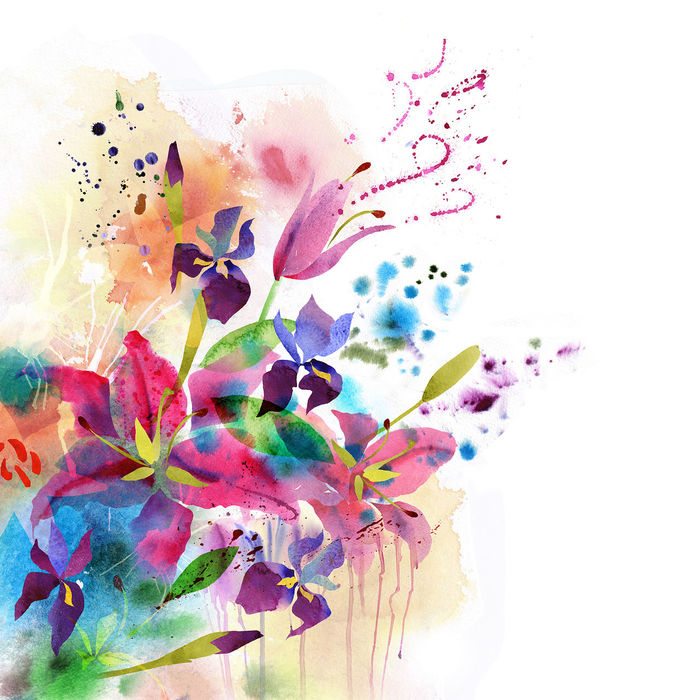
Art classes can bring very significant results in achieving personal harmony. They will allow you to be alone with yourself, think over the situation well and sort out your own feelings without offending others, help you calm down, switch from unpleasant thoughts to constructive action, and, in the end, will allow you to enjoy yourself and please others with the results of your creativity.
Watercolor is one of the most poetic types of painting. Very often in the literature the word “watercolor” is used. Usually this is called some kind of light lyrical sketch, or a short story full of bright, clear, gentle images. Musical works with charming, transparent melodies are also compared with watercolor.
Watercolor – (from French aquarelle – water, from Latin aqua – water) paint for painting. It consists of finely ground pigment, and water-soluble adhesives of plant origin – gum arabic and dextrin. Honey, sugar and glycerin retain moisture. Another component of paints is ox bile. It prevents paints from rolling into drops, on the contrary, facilitating its spreading. To protect against mold, an antiseptic – phenol – is introduced into the paints.
When dissolved in water, watercolor paints form a transparent suspension of fine pigment, and due to this, they allow creating the effect of lightness, airiness and subtle color transitions.
Watercolor has been known to man since ancient times. This is probably one of the first paints, along with natural ocher, that people learned to make. Back in the time of the Egyptian pharaohs, watercolor was used to write on papyrus. But the difficulty of the technique did not allow watercolor painting to be equal to tempera or oil painting. And for a long time, watercolor was completely ousted from the arsenal of artists. In ancient Rome and Greece, when creating a fresco, watercolor was used only for the contours, or for the background, making painting on wet plaster, and getting watercolor effects.
However, in China, watercolor technique began to develop after the invention of paper in the 2nd century BC. In Japan and China, it was successfully used in landscape, genre and portrait painting. In the XVIII-XIX centuries. watercolors were written on silk, combined with black and colored ink.
In Europe, watercolor painting came into use later than other types of painting.
However, despite its late appearance, in a short time it made such progress that it began to compete with oil painting. Watercolor only became a strong and effective painting when artists began to use such painting methods as easing contours and shading with a brush. These methods began to be widely used in the 18th century. Usually they were used by members of scientific and military expeditions to sketch archaeological and geological objects, plants, and animals.
The watercolor technique requires careful selection of materials and, in particular, paper.
Watercolor paper should be of good quality, thick. The surface of the watercolor paper should not be too smooth to hold the dye particles.
Watercolor is diluted with water and applied to paper with a soft squirrel or kolinsky brush. The use of vegetable rather than animal glue as a binder provides a special plasticity of the smear. This is dry work. Watercolor is light, thin and transparent; it is indispensable on trips, in the open air.
But it also has difficulties. Alterations, corrections here are almost impossible. When mixing more than two or three colors, the paint loses its brightness and purity. When the ink layer is washed off, the surface of the paper is disturbed, which often leads to dirt. (By the way, M. A. Vrubel was able to work with watercolors for a long time, reworking individual pieces many times, and such work requires great experience and skill.)
Therefore, the most common manner of watercolor painting in one go or “wet”. In this case, the surface of the paper is preliminarily evenly moistened with a sponge. Then the paint easily lays down, washes off, flows from one to another .. A slightly blurry stroke gives watercolor painting a special softness and texture. The gradual drying of a sheet of paper makes it possible to apply soft “fills”.
Articles on the history, fundamentals, applications, and various forms of art therapy can be found here.
Only the best offers, interesting company news, useful innovations and no spam!