


Art therapy
This is a quote from the post Katerina_2011 The original post Unusual ways of drawing
You can draw not only with ordinary paints and brushes. There are many unusual and fun ways to draw that your children will love and instill in them a love of creativity.
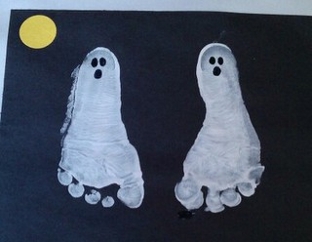
Hand and foot prints
You can draw not only with your fingers, but also with your palms and even legs. These interesting works can be made from the prints of arms and legs, if you apply a little imagination.




Ice cube drawing
You will need:
– Thick paper
– Tempera (or watercolor)
– Form for ice
– Toothpicks
How to draw:
Pour water into the mold and place in the freezer. When the water is half frozen, insert a toothpick into each cube and let the water freeze completely. Then take out the ice. You will use the cubes as brushes by holding them by the toothpicks.
On paper, apply a few spots of different colors (either dry tempera or crumble watercolor) and draw on them with ice! For example, one and the same cube can cross all the spots of paint, allowing them to play intricately.
milk painting
You will need:
– A quarter cup of condensed milk
– Food colors
How to draw:
Mix condensed milk with paints, pour into separate containers (jars or molds) by color. The resulting paints must be applied in a thin layer, because. they take a long time to dry.
Shaving foam drawing
You will need:
– Shaving foam
– Food colors
– Aluminium foil
How to draw:
Tear off a long sheet of foil and apply a few “heaps” of shaving foam to it. Let the child choose the colors of the paints and mix them into the foam. Paints are ready, now you can paint with brushes or fingers. The main thing is to explain to the children that the foam should not be put in the mouth. After the drawing dries, the foam will create an interesting texture. After drawing, the foam is easily washed off the skin and any household surfaces.
Drawing with a toothbrush
You will need:
– Old toothbrush
– Dye
– Paper
How to draw:
It’s very simple: a toothbrush serves as a brush. You can draw a face with a pencil on gray paper and “brush” his teeth with a toothbrush and white paint. And then paint the face.
Bead drawing
Cut out a piece of thick colored cardboard and place it in the bottom of a pie dish, tray, or similar. Apply a few drops of paint to the cardboard, and then, while the paint is still wet, put some glass beads on top and roll them around – and see what happens!
Bubble painting
Mix some watercolor into the bubble soap solution. Lay drawing paper on the floor and ask your child to blow bubbles – they will sit on the paper and create fancy patterns.

Straw blowing
Dilute some paint and pour a small amount onto the paper, give your child a straw and let them blow out any pattern (just make sure the child blows on the paint, not suck it up).
Another way to draw with soap bubbles: in a glass with a colored soap-foaming solution, bubble up more foam and lean paper on top of it.

Frosty patterns on glass – we make and draw our own window, photo, description
If the frost has not reached your windows, then let’s make our own window with a frosty pattern. Nothing worse than the real thing.
Materials needed: blue and white gouache, wide paintbrush, cocktail straw, glossy silver cardboard, pencil, glitter for decoration, masking tape 1.5 cm wide.
How we do:
1. Draw a window on the cardboard, stick masking tape along the contour.
2. Paint the surface of the cardboard with blue gouache. There is a moment here: gouache cannot be diluted with water, otherwise too liquid paint will flow under the adhesive tape and the contours of the window will become fuzzy.

3. As soon as the blue paint dries, dilute the white gouache with water, take a straw and blow out frosty patterns.

4. After the frosty patterns have dried well, carefully remove the tape. You should get a window with frosty patterns on the glass.

5. Decorate the picture with sparkles.
Mirror drawing
Fold a sheet of paper in half, draw a simple shape on one half – or maybe just sprinkle a little paint. Then straighten the sheet and lay the second half on top of the painted one. Allow the ink to print and flatten again, and then study the resulting mirror image together.
Spray
Cut out a large piece of cardboard and place it on a table or floor. Place a piece of drawing paper on top. The cardboard will protect the surrounding surfaces from splashes. Then dilute the watercolors well, take a hard brush or toothbrush – and splatter the paint on the paper. Show your child that you can make beautiful splashes by running the bristles over a hard piece of paper or a wooden stick.

In the same way, you can make drawings using a stencil.
Place a stencil on colored paper. It can be various flowers, silhouettes of houses, trees. In a jar of yogurt, liquidly dilute the paint. Dip your toothbrush into the paint and run the ruler along the bristles of the brush towards you, spattering the paint around the silhouette. Try to have the entire background covered with specks. Remove the stencil and draw details on the “clean” part of the drawing. You can also use tree leaves as stencils.
Spray
Take an unnecessary spray bottle and fill it with water and paint – and go paint. To do this, it will be more convenient to take a large sheet of paper or even a piece of old wallpaper. It is best to draw outdoors like this.
Blotography
It consists in teaching children how to make blots (black and multi-colored). Then a 3-year-old child can look at them and see images, objects or individual details.
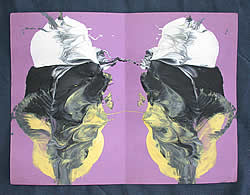
You will need gouache, a thick brush and paper (preferably 1/2 or 1/4 sheet).
Fold the paper in half and unfold it again. On one half, ask your child to put a few bold blots, strokes or curls. Now fold the sheet in half again and press firmly with your palm. Unfold the sheet carefully. You will see a bizarre pattern “What does your or my inkblot look like?”, “Whom or what does it remind you of?” – these questions are very useful, because develop thinking and imagination. After that, without forcing the child, but showing, we recommend moving on to the next step – tracing or drawing the blot. The result can be a whole story.
bitmap
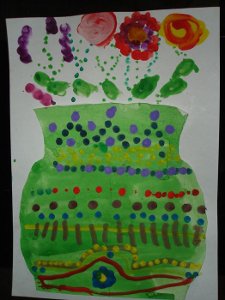
Children love anything non-traditional. Drawing with dots refers to unusual, in this case, techniques. For implementation, you can take a felt-tip pen, a pencil or an ordinary stick for cleaning your ears. But here, bitmaps are best obtained with paints.

You will need a separate stick for each color. With this technique, lilac or mimosa flowers are perfectly obtained. Draw twig lines with a felt-tip pen. And already make clusters of flowers with chopsticks. But this is already aerobatics! No less pleasure will bring the child and drawing simpler things – flowers and berries (stalks can be drawn with a felt-tip pen). Or you can cut a dress out of paper (a scarf, a tablecloth, mittens) and decorate it with an ornament of dots.
Sponge
For some reason, we all tend to think that if we paint with paints, then we must also use a brush. Not always. Foam rubber can come to the rescue. We advise you to make a variety of various small geometric figures out of it, and then attach them with a thin wire to a stick or pencil (not sharpened). The tool is ready. It turns out a large brush without hairs. The stick is held strictly perpendicular to the surface of the sheet, without tilt. Now you can dip it in paint and use the stamp method to draw red triangles, yellow circles, green squares (all foam rubber, unlike cotton wool, is well washed). At first, children will randomly draw geometric shapes. And then offer to make the simplest ornaments out of them – first from one type of figure, then from two, three.
The trace left by such a “brush” can imitate animal hair, tree crowns, snow. A stick with foam rubber is dipped in paint (the main thing is that there is not a lot of water), and the baby begins to cover the sheet with traces of it. Let him first just understand that with the help of the “magic wand” you can quickly and easily draw footprints. Then draw the branches of a tree or a bush with a black felt-tip pen, let the child finish the foliage with green, yellow, red or orange paint. Draw a simple outline of a bunny or a fox with a pencil, let the kid “stomp” it with his “magic tool” – the bunny and the fox will turn out fluffy, their fur will seem so disheveled that the baby will certainly want to touch it.

It is extremely interesting to work in this technique with a stencil.
Cut out an image in the middle of a thick sheet of cardboard, such as the head of a tiger cub or a bear. Attach the cardboard with the cut-out stencil to the album sheet and invite the child to “trample” that part of the album sheet that is visible through the stencil hole. After the child has done this, let the work dry, then paint the eyes, mouth, mustache, stripes with a brush.
Negative
Glue a sheet of white and a sheet of black paper so that you end up with a large sheet, one half of which is black and the other is white. Give the child black and white gouache and offer to draw the same simple drawing, first with white paint on black, then with black paint on white.
Leaves
Gather some leaves and lay them out on a piece of paper. Prepare a well-diluted watercolor and a sponge. Dip the sponge into the paint and apply over the leaf, so that the area around it is painted. Then carefully remove the leaf.

Such an uncomplicated form of artistic creativity as non-traditional painting with leaf prints is great for little artists for whom the brush is still a difficult tool. It turns out that a seemingly ordinary leaf (maple, poplar, oak or birch) can turn into a tool for artistic creativity no worse than a brush.
What will we need?
• Paper
• Leaves of different trees (preferably fallen);
• Gouache
• Brushes.
Progress:
The child covers a piece of wood with paints of different colors, then applies it to the paper with the painted side to make a print. Each time a new leaf is taken. The resulting drawing is finished with paints as desired. This is how it turns out:


Picture in passe-partout technique
On the sheet, draw an apple, a fish or a car in the center of the sheet. And now you need to cut out the object that you drew along the contour. It turned out to be a passport. In pictures, only part of the image can be cropped. The fish has part of the body, tail, fins. Give your child a sheet of paper. Let the baby smear the paint, slap the palms on the sheet and leave marks. Glue the passe-partout onto a sheet painted with crumbs. The kid will be very surprised and happy when he sees a multi-colored bright fish (car or girl).

“Figured” figurine
A very interesting way of drawing with a pencil, felt-tip pen, ballpoint pen according to pre-made stencils. Stencils can be of two types – some are cut inside the sheet, others are made from the sheet and separated from it. It is easier for small children to circle figures embossed inside the sheet. Many squares and rulers have such patterns. Attaching them to the album sheet, you ask the baby to circle the shapes. Then you remove the stencil and together with it you come up with how you can finish drawing this or that shape. Children 4.5-5 years old will be able to circle single stencils cut out of cardboard. This is more difficult, because the hand does not hold well on the outside of the pattern and the baby draws extra lines. But children can be interested in the content of stencils: for boys, these are the silhouettes of cars and planes, for girls, animals, nesting dolls, bows and houses. Having circled the patterns, children can paint over their images with felt-tip pens and paints, hatch with various lines: straight, wavy, zigzag, with loops, wavy with sharp tops. Stencils can help when creating your own drawings, they will complement what the baby himself has created.
You can start a game: the child circles various objects, and you guess what it is. First, not all items can be circled. Finding them, the baby will understand the difference between voluminous and flat objects or things that have at least one even side, and those that do not. Secondly, it is not easy to circle this or that object on your own, without the help of an adult. And thirdly, in this game, the roles change: the baby confuses the parents, and the adults try to find the answer. All this pleases the child, providing him with a surge of creative forces.
Mysterious thread drawings
Mysterious drawings can be obtained as follows. A cardboard about 20×20 cm in size is taken. And it folds in half. Then a semi-woolen or woolen thread about 30 cm long is selected, its end is dipped in thick paint for 8-10 cm and clamped inside the cardboard. You should then move this thread inside the cardboard, and then remove it and open the cardboard. You can dye several threads in different colors at the same time. It turns out a chaotic image, which is examined, outlined and completed by adults with children. It is extremely useful to give names to the resulting images. This complex mental and speech work, combined with visual work, will contribute to the intellectual development of preschool children.

Threads can be drawn in other ways. Cut a woolen thread about 20 cm long, dip it in paint and give it to the baby. Let him run the thread across the sheet of paper as he pleases. Then do the same with another thread and new paint. Multi-colored lines, zigzags, stains will remain on the sheet. In a word, a beautiful abstraction.
Drawing with crayons
Preschoolers love variety. These opportunities provide us with ordinary crayons, sanguine, coal. Smooth asphalt, porcelain, ceramic tiles, stones – this is the base on which chalk and coal fit well. So, asphalt disposes to a capacious image of plots. They (if there is no rain) can be developed the next day. And then make up stories according to the plots. And on ceramic tiles (which are sometimes stored in the remains somewhere in the pantry), we recommend depicting patterns, small objects with crayons or charcoal. Large stones (such as boulders) are asked to decorate them under the image of an animal’s head or under a stump. It depends on what or whom the stone resembles in shape.
Magic Drawing Method
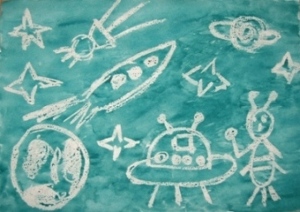
This method is implemented like this. An image is drawn on white paper with the corner of a wax candle (a Christmas tree, a house, or maybe a whole plot). Then with a brush, and preferably with cotton wool or foam rubber, the paint is applied on top of the entire image. Due to the fact that the paint does not fall on the bold image with a candle – the drawing seems to appear suddenly before the eyes of the children, manifesting itself. You can get the same effect by first drawing with stationery glue or a piece of laundry soap. In this case, the selection of the background to the subject plays an important role. For example, it is better to paint a snowman painted with a candle with blue paint, and a boat with green paint. No need to worry if candles or soap start to crumble while painting. It depends on their quality.

.
photocopy
We draw a drawing with a candle on a white sheet. Paint over with black ink.
Drawing small pebbles
Of course, most often the child depicts on a plane, on paper, less often on asphalt, tiles of large stones. A flat image of a house, trees, cars, animals on paper is not as attractive as the creation of volumetric own creations. In this regard, sea pebbles are ideally used. They are smooth, small and have a different shape. The very shape of the pebble will sometimes tell the child what image to create in this case (and sometimes adults will help the kids). It is better to paint one pebble under a frog, another under a bug, and a wonderful fungus will come out of the third. Bright thick paint is applied to the pebble – and the image is ready. And it’s better to finish it like this: after the pebble dries, cover it with a colorless varnish. In this case, a voluminous beetle or a frog made by children’s hands shines, brightly shimmers. This toy will participate in independent children’s games more than once and bring considerable benefits to its owner.

strange patterns
Take whatman paper and a small orange (tangerine) or a ball, pour a little paint of a different color on a sheet and roll the ball along the sheet in different directions. Then “revive” the received.

Finger painting method
Here is another way to depict the world around us: with fingers, palm, fist, foot, and maybe even chin, nose. Not everyone will take such a statement seriously. Where is the line between prank and drawing? And why should we draw only with a brush or felt-tip pen? After all, a hand or individual fingers is such a help. Moreover, the index finger of the right hand obeys the child better than a pencil. Well, if the pencil is broken, the brush is wiped off, the felt-tip pens are over – but you want to draw. There is another reason: sometimes the theme just asks for a child’s hand or finger. For example, a child will better draw a tree with his hands than with other tools. With his finger he will draw out the trunk and branches, then (if it is autumn) he will apply yellow, green, orange paints on the inside of the hand and draw a crimson-mahogany tree on top. It is good to mix several colors and shades. For example, first apply yellow paint, and then brown or orange, it turns out fluffy!
Well, if we teach children to use their fingers rationally: not just one index finger, but all.
Monotopy method
Two words about this, unfortunately, rarely used method. And in vain. Because he is fraught with a lot of tempting for preschoolers. In short, this is an image on cellophane, which is then transferred to paper. On smooth cellophane, I paint with paint using a brush, or a match with cotton wool, or a finger (no uniformity is needed). The paint should be thick and bright. And immediately, until the paint has dried, turn the cellophane over with the image down on white thick paper and, as it were, wet the drawing, and then lift it up. It turns out two drawings. Sometimes the image remains on cellophane, sometimes on paper.
Drawing under the film
We squeeze out the paint onto cardboard or paper, put the film on top and smooth it with cotton wool, then sharply pull the film away. In this way, the sunset, the sea, the fire are good …
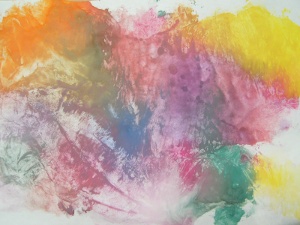
Drawing on wet paper
Until recently, it was believed that you can only draw on dry paper, because the paint is sufficiently diluted with water. But there are a number of objects, plots, images that are better to draw on wet paper. We need ambiguity, vagueness, for example, if the child wants to depict the following topics: “City in the fog”, “I had dreams”, “It’s raining”, “Night city”, “Flowers behind the curtain”, etc. You need to teach a preschooler to make the paper a little wet. If the paper is too wet, the drawing may not work. Therefore, it is recommended to soak a ball of cotton wool in clean water, wring it out and draw it either over the entire sheet of paper, or (if required) only over a separate part. And the paper is ready to produce vague images.
Drawing with postcards
Almost every house has a lot of old postcards. Go through old postcards with the children, teach them to cut out the necessary images and stick them to the place, into the plot. A bright factory image of objects and phenomena will give even the simplest unpretentious drawing a completely artistic design. It is sometimes difficult for a three-, four- and even five-year-old child to draw a dog and a beetle. They can be taken ready-made, and for the dog and the bug, let him finish the sun, rain, and he will be very happy. Or if, together with the children, cut out from a postcard and stick on a fairy-tale house with a grandmother in the window, then a preschooler, guided by his imagination, knowledge of fairy tales and visual skills, will undoubtedly draw something for him.
Whose footprint
Another way of drawing, or rather, printing, is based on the ability of many objects to leave colorful prints on paper. You take a potato, cut it in half and cut out a square, a triangle, a rhombus, a flower or something interesting from one half. Moreover, one side of the print should be flat for applying to the paper, and you will hold on to the other side with your hand. Then you or a child dip such a signet in paint (preferably gouache) and apply it to paper. As you can guess, it leaves an imprint. With the help of these prints, you can make beads, ornaments, patterns, mosaics.
Not only potatoes can serve as a stamp, but also bottle caps, caps from felt-tip pens, buttons, small boxes, etc.
You can try to depict something according to the principle of designing from different parts. For example, a car (coil – wheels, cubes – body and window); the castle of the sorceress, animals, etc.

You can paint the wheels of a toy car with paint and drive it around on paper.
An interesting print in the form of a rose is obtained from the remains of a head of Peking (Chinese) cabbage.


salty drawings
But what if you paint with glue, and sprinkle salt on top of these areas? Then you get amazing snow pictures. They will look more impressive if they are performed on blue, blue, pink colored paper. Try it, it’s very exciting!
tooth paint
Or let’s create winter landscapes in another way – painting with toothpaste. Beforehand, the kid needs to be explained that this is a creative search, and such use of toothpaste does not give him the right to squeeze it out on the floor, shelves and tables. Together with the baby, outline with a pencil the light contours of trees, houses, snowdrifts. Slowly squeezing out the toothpaste, go through all the outlined contours with it. Such work must be dried and it is better not to put it in a folder along with other drawings. For creativity, it is best to use a domestic product – it dries faster.

Relief drawing
Flour is added to the paint, applied to the sheet. The cardboard strip is cut into teeth and we draw patterns along and across. Cut out a shape from a dried sheet, for example a vase. We draw flowers on a white sheet, and then glue them. You can draw with a stick, a toothpick, a fork, a match.
glue picture
We squeeze glue onto the image on paper, let it dry, and then paint it over with paint, we get a relief.

Like an artist to an artist
And here is a very unusual way! You need to get a large sheet of paper. You ask the baby to lie on such a sheet and circle it. Of course, it is better that it fits all (this can be achieved by gluing two or three sheets of whatman paper) or, in extreme cases, to fit the torso and head. You circled the baby, and now his time has come – let him try to decorate the silhouette: draw eyes, mouth, hair, jewelry, clothes. If the child is small, then do this work together – the kid offers, and you, admiring his imagination, draw with him.
rainy fantasy
Another option for unconventional drawing is as follows: during rain or snowfall, you boldly open the window and expose a sheet of paper for less than a minute, holding it horizontally. You probably guessed that drops of rain or snow will remain on the leaf. And this is what we were striving for. Bad weather tracks can now be traced and turned into fabulous creatures. They can also be connected to each other, guessing what kind of image is obtained.
Point drawing
An adult prepares a drawing scheme in advance, placing contour points. They say to the child: “Do you want to be surprised? Then connect the dots with each other in order!” Offer to finish the resulting contour, color it, come up with a plot and a name.
Picture from both sides
You will need a cardboard sheet, a wide brush, paper clips, colored pencils. First you need to paint over a sheet of cardboard with any paint (an old cardboard folder will do). Immediately, before the paint is dry, place a sheet of plain white paper (preferably writing paper) on top. Attach the paper with paper clips and let the child draw something with a colored pencil on a white sheet. If you want, you can use a coloring book, but the drawing should be simple – some kind of object. When the drawing is finished, unfasten and remove the paper. See what happened – on the side that was pressed against the folder, we got a color picture with a convex, as if imprinted pattern.
scratches
Take a thick paint that is not diluted with water (it is better to use acrylic or gouache) and draw a colored spot. Scratch the lines with a piece of cardboard or crochet hook. Or you can cut out the cardboard with cloves and scratch the scallops in the paint. Crochet through different curls. With the edge of the cardboard, extrude the lines crosswise. Make prints with the cap of a felt-tip pen. After the child has mastered this technique, you can begin to create a picture. To do this, apply paint of different colors on several sheets of paper and scratch the surface in different ways. Now assemble the composition. For example, cut a pond from a piece with scallops, a sky with clouds from curls, make a snake from a scaly surface, and so on. Paste the cut out elements on a blank sheet of paper.

We draw with gouache using the poke method
You will need gouache, a brush, landscape sheets. The child holds a brush in his hands and puts it perpendicularly on the paper. Show how your brush jumps! With this poke method, you can draw a salute, you can color a fluffy cat (the cat should be drawn in advance with a felt-tip pen or pencil), you can also color flowers.
Collage
The concept itself explains the meaning of this method: several of the above are collected in it. In general, ideally, the following seems important to us: it is good when a preschooler is not only familiar with various image techniques, but also does not forget about them, but uses them appropriately, fulfilling a given goal. For example, one of the children of 5-6 years old decided to draw summer, and for this he uses a bitmap (flowers), and the child draws the sun with his finger, he cuts fruits and vegetables from postcards, depicts the sky and clouds with fabrics, etc. There is no limit to improvement and creativity in visual activity.
English teacher-researcher Anna Rogovin recommends using everything that is at hand for drawing exercises: draw with a cloth, paper napkin (folded many times); draw with dirty water, old tea leaves, coffee grounds, pomace from berries. It is also useful to paint cans and bottles, reels and boxes, etc.
Source: http://luntiki.ru , http://stranamasterov.ru , http://www.kalyamalya.ru , http://www.umka.by , http://adalin.mospsy.ru/l_03_00/ l0177.shtml
Based on articles by Sherri Osborne. Sourced from FreeKidCrafts.com.
A series of messages ” Creativity joint with children “:
Part 1 – CREATIVE JOINT CREATIVITY WITH CHILDREN
Part 2 – Airbrushing for kids
…
Part 4 – Super Flowers!!!!
Part 5 – Thread snowman. We are preparing for the new year
Part 6 – Unusual ways of drawing
Part 7 – Sunny Pictures
Part 8 – Crafts with children. SOCCER BALL AND POLYHEDRALS FROM COLOR PAPER.
…
Part 15 – Stamping. Leaves. Let’s draw with the kids!
Part 16 – Corals. Simple and original.
Part 17 – Oh those splashes! Alcohol ink.
Articles on the history, fundamentals, applications, and various forms of art therapy can be found here.
Only the best offers, interesting company news, useful innovations and no spam!