


Art therapy
This is a quote from the message TATIK_222 The original message Scientists believe that needlework affects the level of “female” hormones!
Nature takes its toll, and women again want to feel like women – weak and defenseless. They cross-stitch, weave beadwork, make beads and clothes from wool, do patchwork and quilting. Perhaps this is a kind of “subconscious psychotherapy.”
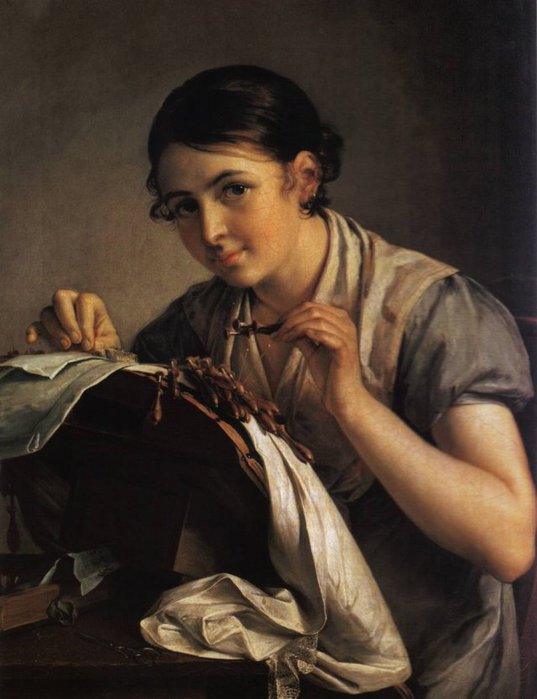
V.A. Tropinin. Lacemaker
In the hustle and bustle of urban life, ladies activate their rational left-hemispheric logical thinking, leaving almost no room for creativity. While needlework, a right hemispheric process is launched, illogical, spontaneous – creative.
Needlework can also be called the most real psychotechnics, thanks to which we restore the family connection, and therefore it is very correct to teach the skills of embroidery and sewing to girls from a very early age. Often, female psychotherapy contains a return to the origins, it is an attempt to reconstruct the family line, the energy flow that was given to us from our mothers, grandmothers, great-grandmothers.
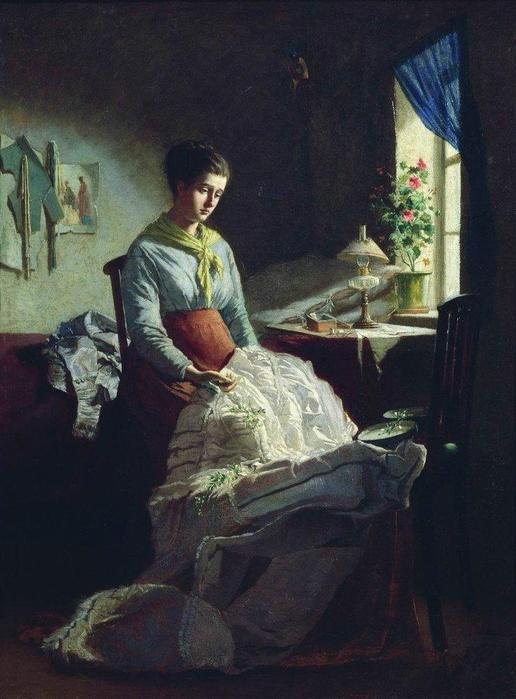
Klodt. Tired seamstress
Many cases are conventionally divided into male and female.
There is a stereotypical idea that a real man should be able to handle a hammer, and also plan, saw and fix all sorts of malfunctions around the house. In turn, we a priori endow the representatives of the weaker sex with the ability to cook, sew, knit … The only thing is that modern people are less and less engaged in purely male and purely female affairs. Many in offices press the same keys on the computer, and at home they also press, only on the buttons of the washing machine, microwave, television remote control. Does such universality of occupations affect the human essence? Scientists are sure that it affects, and how.
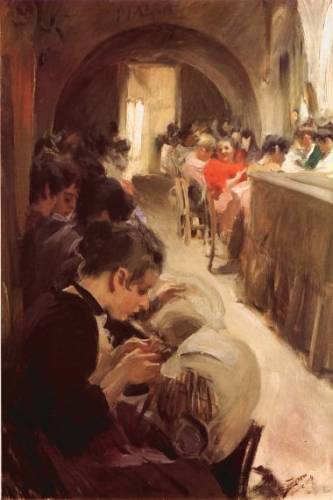
Anders Zorn. Lacemakers at work
And already, using the example of the weaker sex, they proved that the rejection of manual labor makes women less feminine, and this process occurs at the hormonal level.
Until recently, the following fact appeared as a hypothesis: sex hormones in women have a strong influence on the choice of profession.
Scientists at the University of Pennsylvania decided to test this version and organized a study during which they studied the professional preferences of women with different levels of hormones. So, girls with congenital hyperplasia, in which the normal production of “female” cortisol is disrupted in the adrenal glands and there is an excessive release of androgens (male sex hormones), had more “male” interests.
They chose professions in the field of technology, engineering, and mathematics.
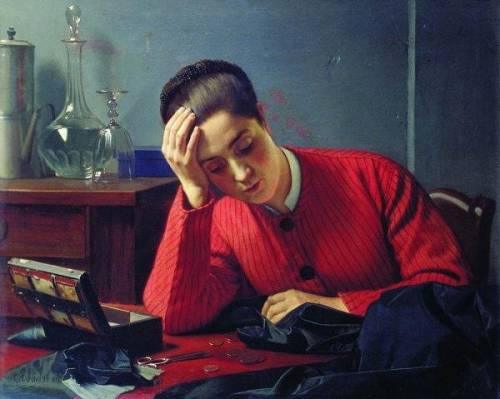
Konstantin Makovsky. Seamstress
Scientists believe that there is an inverse relationship: just as hormones affect the choice of women’s occupation, so classes can affect hormone levels.
If a woman is forced to engage in heavy physical labor, she may eventually lose her femininity, acquiring coarse physical features.
Accordingly, the representatives of the weaker sex, who are fond of purely women’s affairs – knit, sew, embroider, say, with a cross – are more feminine and have a balanced character.
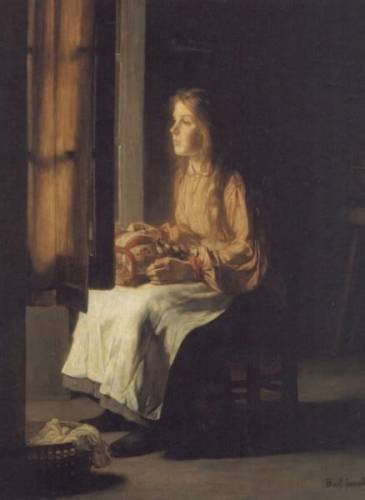
Joseph Bale. embroiderer
Here is how it is regulated at the hormonal level. By making small movements with their hands, for example, during embroidery, women thereby involuntarily improve the work of the hypothalamic-pituitary system, which controls the production of luteinizing hormone (it stimulates the secretion of estrogen by the ovaries), follicle-stimulating hormone (the reproductive system depends on it), prolactin (affects mammary glands) and other important hormones.
“Needlework, which is carried out by movements that activate fine motor skills, evens out the hormonal background in the body,” explains Irina Kratynskaya, chief physician of one of the capital’s medical centers. – Why, for example, do children need to develop fine motor skills so that they speak better? This is how brain connections are established. The same thing happens with needlework. In general, the hypothalamic-pituitary system regulates itself – a decrease in the level of some hormones leads to an increase in others.
However, you can help this process with your own hands – take a needle and thread, and stitch by stitch … ”
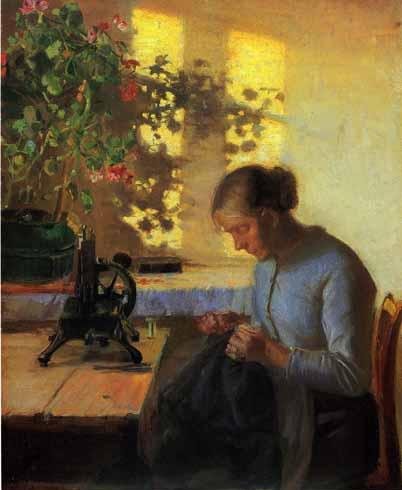
Anna Ancher. The fisherman’s wife sewing
Articles on the history, fundamentals, applications, and various forms of art therapy can be found here.
Only the best offers, interesting company news, useful innovations and no spam!