


Art therapy
Drawing lessons
Interview with Edith Kramer
about her studies with Friedl Dicker-Brandeis
Free translation by Elena Makarova and Alexey Lelchuk
Divide and rule. Look at the world from different points, choose and concentrate on one quality, for example, rhythm, texture, how a thing is made, composition. Explore and work with this quality, then with others. Then put everything together without confusion in order.
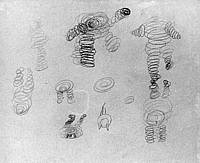
How things are made. Knitting – it is important not just to see a knitted thing in front of you and draw it, for example, a sweater. It is important to imagine vividly how the thread enters and exits, twists, intertwines. It is important to imagine how the thing was made, how it was in motion, during growth.
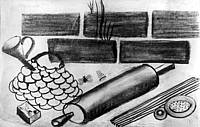
Dictations on the essence of things. We quickly drew on one sheet a lot of inappropriate things that Friedl called us. There was no time to look at the form of a thing, it was necessary to feel its essence, what is most characteristic of it, how it is made. It was a great assignment, because we never knew what would happen next – her imagination was inexhaustible.
Tulip. How he grows, where he moves, what he wants – that’s the drawing. It is necessary to understand what is happening in a thing – how a flower grows, where it wants to grow, what hinders it. Then you have a plan, and you draw how the flower lives, and not just a dead form.
Wire. We drew a human figure, a vase or a jug, as if made of wire, so that everything that happens inside is visible.
Exercise – one person talks about a thing that he drew or wanted to draw, and the rest draw it, but not the way they would draw it, but the way this person would like to draw it. The idea of the exercise comes from dictations – drawing from the outside, not by choice. If this is a drawing where color is important, or emotions, or movement, it was necessary to carefully listen to how this person talks about his experiences and emotions.
Rhythm dictations. One-and-twoaaa – one-and-twoaaa – Friedle gave the rhythm with her voice, and we drew it with charcoal on paper. Arcs, stripes, waves. From the drawing you could then read the rhythm. Botticelli has very complex rhythms. Strong and complex. I redrawed his paintings with pencil and charcoal. Also the Chinese – the whole pattern is purely rhythmic.
Rhythm is everywhere. They say you need to be able to draw a straight line. I say – do not draw straight lines at all. But if you need to, then you take the rhythm of a straight line and op! – straight line. There’s texture, there’s size, there’s space, but rhythm brings it all together because it’s so versatile. Only color has nothing to do with rhythm. Color is a completely different story.
The good thing about color collages is that the colors are pure and don’t mix.
In drawing on large sheets, not only the hands are involved, but also the shoulders, the whole body. The whole body enters into rhythm – it’s easier than grinding on a small sheet. Large exercises allow later in small drawings not to lose rhythm and draw rhythmically. You can draw with both hands at the same time – you get such vases.
If a picture is bad, it looks small. If the picture is good, it seems big, no matter the size.
It seemed that Friedl did not have a system – different tasks were interspersed.
When I became good at drawing with charcoal, she forbade me to draw with it. She ordered me to draw with a pencil, or ink, or watercolor – something more strict, not as simple as charcoal. Charcoal paints itself, it has texture and rhythm by its very nature. And in order to get a texture with a pencil, you need to work hard.
Friedl said: I know that you can draw an eye so that it looks like an eye. But you have to get the real quality of the eye, not just a description of the things that are there. This requires complete concentration.
If you draw a portrait of a person but don’t know where his ass will be, then you won’t paint a good portrait. You need to have a complete understanding of what you are drawing and draw this representation. She asked me to draw a person, starting from the feet, not from the head. Or start from the background.
Friedl said: I know you’re talented, but what you do with that talent is what matters.
The child needs to be praised, accepted, demanded nothing but enthusiasm for what he draws. A child cannot be taught anything except what he already knows, but does not know what to call it. An adult or teenager should know what he is doing and what is required, but children just grow up, and sometimes they may decide to learn something. Children go through very predictable stages in their development, and there is no need to interfere in this in any way.
The old way of teaching – master and student – is much better than what is accepted now, when a person learns different things from several teachers. Previously, if you are not a very original artist, then you just do what the master did, and nothing worse than the master did, and you have your own piece of bread. If you yourself are an original artist, then you can go ahead, but you will always have a solid base. You will only do something new if there are serious reasons for it. And now, when you have N teachers who teach you N different things, and you don’t know what is good and what is bad, and what fits with what.
(Lena’s comment and mine: in the twentieth century, everyone is trying to invent something new, but firstly, there is not much new that can be invented quickly, especially in art, and secondly, it is often better to just do something well old. Thirdly, it is the projection of science onto art. In science, success is a new discovery, and now it has been adopted in art. But art is a completely different matter; beauty is eternal.)
Itten’s introductory course, people’s talent selection. One student wanted to study architecture, but everything she did was flat, non-dimensional. Itten advised her to take up textiles – now she makes very good tapestries.
When children learn to write, this is a dangerous moment. Writing is the second signaling system. What you do with your hands is not related to the meaning of what you want to say. It’s just badge writing technology. Drawing is the first signaling system. Hands should get up on paper exactly what you want to say. When children learn the second system, the first becomes dull, and special efforts are needed so that it does not die out completely.
1.
Articles on the history, fundamentals, applications, and various forms of art therapy can be found here.
Only the best offers, interesting company news, useful innovations and no spam!