


Art therapy
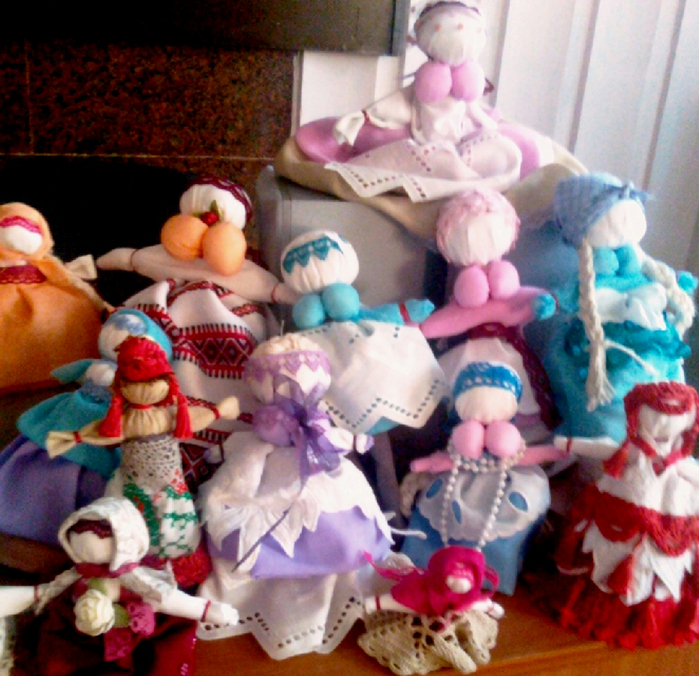
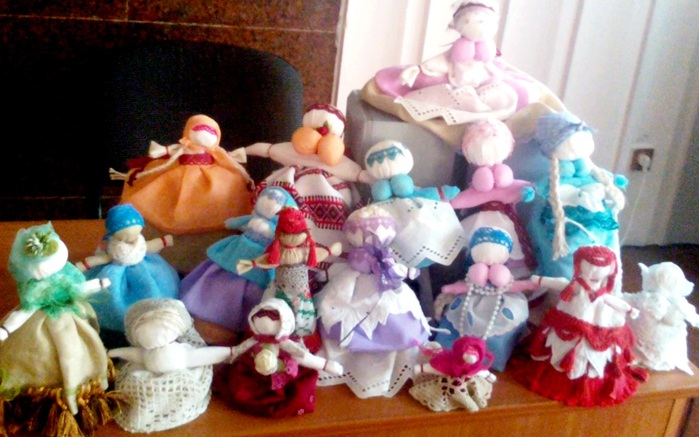
The Ukrainian motanka doll is a unique phenomenon that our ancestors left us as a gift. The motanka doll is universal: it is made according to the same principles, whether it be to harmonize family relations, for healing or a talisman. But the most mysterious is the presence of a cross on the face. What secret hides in itself this coastline?
SACRED MEANING The Ukrainian motanka doll contains many sacred cosmogonic meanings that were formed back in the Trypillia era. Therefore, many researchers (A. Naiden, L. Timoshenko and others) believe that the origins of the motanka doll are in the Trypillia culture. So, at the base of her head, she has a twisted svarga, which is the main motif on the Trypillia clay products. Svarga symbolizes the movement and development of the universe. The word “development” itself contains the image of a coil: in the process of development of something, coils seem to spread. Indeed, the process of winding the doll resembles the spiral movement of the Universe, as if energy whirlwinds are twisting. In addition, twisting, curling conveys the image of a layered structure of human thin bodies, as Zinaida Zimina notes in the book Textile Ritual Dolls. In general, curling is a ritual action that correlates with the birth, growth, multiplication, is associated with the creation of the world (“whirlwind”, “midwife”, “spovivati”, “verch” – wedding bread, and many others).
The ancient origin of the motanka doll is also indicated by the fact that it has a cross instead of traced facial features. It is known that the eyes are the “mirror of the soul”. The eyes were not depicted on the sacred doll, so that there would be no identification with any living being. People believed that the soul could fly into the eyes. The cross on the face of the sacred doll, as it were, testifies to its being outside of space and time, therefore it is an archetype, an image of the Great Goddess, a conductor of her power. This is what makes it sacred. The indicated facial features, as it were, impose a certain image, dispel the haze of mystery, the unknown, drive it into frames and thereby desacralize the doll, that is, make it an ordinary toy. After all, behind a cross-like face, you can fantasize any image you like in accordance with your inner world. The finished image may not correspond to the energy of the person for whom the motanka doll is created, as a result of which the person may not perceive the doll as a reflection of his inner world, and then the doll will not become a talisman, but will be perceived as an independent being living separately from the owner. And the essence of the motanka doll is in continuous energy exchange with its owner.
In addition, the cross in a circle is a sign of Dazhdbog, that is, a symbol that carries solar energy. And our ancestors called themselves “grandchildren of Dazhdbozh”. The cross is also a symbol of the harmonization of the spiritual (vertical line) and the body (horizontal line), similarly to the heavenly and earthly, male and female principles.
SECRETS OF THE MAGIC OF THE MOTANK DOLL In the name of the motanka doll lies its essence: this doll is not knitted or sewn, it is only wound. You need to use only natural materials. It’s great if the fabric is handmade. Dry herbs, flowers can be woven into the doll, heads of corn can be used, grains can be invested.
This amulet is made practically without knots, since our ancestors were afraid to “tie a share”. It is impossible to touch the doll with piercing objects (needles, scissors), you can offend her, because the doll is a creature inspired by its creator. It is advisable to tear the fabric and threads for dolls with your hands, but you can also cut them, the main thing is not to touch the doll itself with scissors. It is very good to create a doll from pieces of old clothes that belong to loved ones, for example, grandparents, because it is saturated with their energy, and the doll will radiate it, passing it on to descendants. But it is necessary to trace whether these clothes were “happy”. You can not use the clothes that were worn during difficult life situations, during illness, in stressful conditions.
The creation of a motanka doll is the action of a new birth. Each doll is a living being, it carries certain energies. Like a person, she is born only after she finds out her destiny, her task in this world. The doll is a meditative object. Shaking it, the woman is, as it were, between the worlds: feeling a connection with Naviu – ancestors, clearing the past, asserting the power of her faith Yav – the present, “manifesting” the necessary images and thus forming a happy future, righteous thoughts – Rule. By shaking the doll, the woman is shaking her fate. Therefore, the most important stage in the manufacture of a motanka doll is the formation of an idea, concept, image. And already the material is selected for the idea and the name of the doll appears, that is, the idea is realized. The craftswoman must decide: for what purpose she will make the doll, in what way she will help its owner, what innermost desires to realize. For example, to make peace with someone, if they quarreled, then images of forgiveness are laid in the doll, or to solve family problems, then images corresponding to this plan are inserted, etc.
These images are inserted when the roller for the doll’s head is twisted, which resembles the Trypillia spiral. After all, it is in the head that mental images are born, thus, the head of the doll is the main carrier of the energy of the idea of its creator. When we cover this roller with a cloth for the face, we bless this creature. Waving a cross on the doll’s face, you can lay a certain symbolic number. The doll is wound only in a good mood, with prayers, you can fill it with Alive energy, speak, that is, be in a sacred prayer camp. We wind the thread around the Sun (salting), directing energy in the direction of growth and development. By shaking the doll, we are spinning the energy, we are shaking the share. The more we twist the thread, the more energetic the doll becomes. This is a responsible spiritual work. Thus, the doll retains the energy, information of its creator. She always reflects the inner world of the craftswoman, which is manifested in the “character” of the doll: appearance, colors, style of clothing, size, etc.
Of great importance is the day when the doll is rolled up. On Friday – the day of Mokosh and Sunday – the day of the Family, all the Gods – you should not make a doll. So, folk craftsman Valentina Berdnik-Sokorinskaya always adheres to the meaning of holidays and moon phases when making a motanka doll. For example, for fertility, wealth, a doll is made in the waxing phase of the moon, for family happiness and successful business – when the moon is full, and in the waning phase, dolls are made to ward off problems and illnesses.
Conventionally, the work on the motanka doll can be divided into two stages: the creation of the body of the doll and the creation of the outfit. When the doll’s body is dangled, no knots are tied. One knot is tied at the very end, when the doll’s body is swaddled, in the place of the navel, which symbolizes the birth, the tying of the umbilical cord, and at this moment the power of the craftswoman’s intention is fixed. It is believed that when tying a knot, you need to make a wish. Knots are allowed in the manufacture of hands (fixing along the edges of the hand roller), this can be explained by the fact that the hands are made separately, and then attached to the body of the doll. But motanka dolls may not have hands.
The started doll must be completed in order to avoid misfortunes.
An outfit for a doll, until it is tied up, you can embroider, sew lace, jewelry to it. Also, the headpiece can be sewn separately. The elements of the doll’s clothing also have a protective symbolic meaning. The skirt symbolizes the earth, the embroidered wavy line on the apron indicates a connection with water, the shirt – the trinity of the world, the headdress (ribbon, scarf, ochipok) – a connection with the sky.
Sacred motanka doll – a coaster, one of the family members, an assistant in life. It can be placed on a pokutya, near the front door, above the crib, in front of the table. Love and the light of the soul, invested in it, will create a happy fate for the family, clan, and through space and time will pass it on to descendants.
THE WAY TO YOURSELF In the Russian folk tale “Vasilisa the Beautiful”, the image of a sacred doll-assistant has been preserved. Delving into the secrets of this tale, we can clarify a lot in the nature of the female soul.
K.P. Estes in the book “Running with the Wolves. The female archetype in myths and legends” writes that the old tale about Vasilisa is a story about the initiation of a woman, the development of the female soul. Psychologist Razida Tkach in the book “Self-disclosure of a woman with the help of the fairy tale“ Vasilisa the Beautiful ”describes how this fairy tale can be used to work out some psychological problems associated with poor-quality living of certain age stages. Thus, the main goal of the heroine is to acquire the deep wisdom of a woman, without which it is impossible to build a happy life.
To gain inner feminine power, the soul must complete certain tasks. And the very first task is to “let the too-kind mother die.” The tale begins with the fact that Vasilisa’s mother dies, but before her death, along with her blessing, she gives her daughter a doll and orders her to always keep it with her, and if some grief happens, give her food and ask her for advice. Through the chrysalis, the mother conveys to her daughter the female intuition, the ancestral force, which helps the girl to go through all the trials. According to K. P. Estes, the chrysalis expresses the inner female spirit, the voice of the inner mind, inner knowledge and consciousness. She is a symbolic copy of the original “self”, soul, intuition. Keeping a doll with you means receiving maternal help and advice. To feed the chrysalis is to maintain an emotional sensual connection with the mother, one’s kind, with one’s intuition. Sokhan I.V. believes that the mother’s command to feed the chrysalis means “the need for inner work in order not to forget oneself and not to move away from one’s essence and purpose in the variety of everyday concerns, and also the ability to feed, while infringing on oneself, indicates the ability to sacrifice something one-time for the sake of something more important and truly urgent.”
If we perceive the fairy tale superficially, then it becomes very pitiful for Vasilisa, who from now on will not see maternal affection. But in order to understand the secret meaning of this tale, one must understand that all its elements depict the qualities of a single female soul. That is, at the level of images, archetypes, the death of a kind and affectionate mother means farewell to the childhood of the soul, the rejection of excessive maternal care. In order to undergo initiation (initiation) into a real woman, the heroine must take responsibility for an independent life, develop awareness of her actions. This is what symbolizes the death of the mother in the so-called women’s fairy tales.
Further, the disgusting stepmother’s family enters the world of Vasilisa, turning her life into hell. The stepmother and her daughters represent the “shadow” – the “dark” aspects of the soul that the ego drives into the depths of the subconscious. These are the unaccepted parts of the soul that create problems for the heroine. At this stage of initiation, a woman is plagued by petty nit-picking of her own soul: “You don’t deserve better. You are stupid and worthless. You are allowed from now to now and no more.” Thus, the next task of the heroine is to accept the dark sides of her soul, become whole, balance white and black, and therefore become herself. The conflict between a too good, kind, compliant nature and a too demanding, aggressive nature is escalating. The stepmother and sisters want to kill the blossoming soul, therefore they extinguish the fire in the house, without which life is impossible. The extinguished fire symbolizes death for the old way of life. Symbolic death is the first stage in the structure of initiation.
Now Vasilisa is faced with the task of getting fire. Through the dark forest to the hut of Baba Yaga, the doll-intuition leads Vasilisa, that is, the heroine must trust her instinctive nature.
Baba Yaga is the very essence of the instinctive, integral soul. This is a prototype of Mokosh – the wise and fair Goddess, who spins the thread of human destiny. If the visitor treats her with respect, he will grant him a Share, and if he shows ignorance and disobedience, he sends a Nedolya. Baba Yaga inspires fear because it simultaneously personifies both destructive energy and life force energy. Despite all the threats, she is always fair. Respect for great power is a crucial lesson. A woman must be able to stand before the power, because in the end some part of this power will pass to her. Vasilisa asks Baba Yaga for fire, and she agrees, but only if in return the girl will do her homework for her. In the language of images in this way, Baba Yaga teaches Vasilisa to put things in order in the house of her soul. Washing clothes of Baba Yaga symbolizes cleansing, implies impregnation, filling with spirituality, higher power, mystery, since clothes carry her image, energy. Vasilisa learns to renew her soul by erasing the fibers of existence. Sweeping in the hut of Baba Yaga means learning to disassemble, understand, keep in order, cleanse the house of your soul, streamline your inner life. To cook for Baba Yaga, you need to kindle the creative fire of your soul, the fire of love, mold yourself in the image and likeness of the Great Goddess. The task of sorting through the grain, separating the good from the bad, is the development of the ability to accurately recognize, unmistakably separate the true from the false, make subtle differences in judgments, which will help make the right choice in life. With the help of this work, Vasilisa collects herself, structures her psyche. The statusless, intermediate state of the initiate is the second stage of initiation.
For good work, Baba Yaga gives Vasilisa a burning skull. At first glance, a terrifying image (“How can children read this?!”). But at a deep level, the skull symbolizes the connection with the ancestors. In ancient times, bones were considered a means of evoking spirits, and the skull was especially important. Thus, this symbolizes that Baba Yaga gave Vasilisa ancient tribal knowledge, the gift of knowledge. Vasilisa has merged with her power and now sees the world and her life in a new light. When Vasilisa comes home, the skull observes the stepmother and daughters, and then burns them to the ground, that is, the transformation of the shadow sides of the soul takes place. Rebirth in a new quality, return to life in a new status is the third and final stage of initiation.
Vasilisa – the image of the female soul – does a great inner work, thanks to which she undergoes an age-related initiation into a wise woman, gains intuition, integrity, deserves happiness. Now she has inner strength to create her world in love and harmony. She discovered the Wild Woman in herself – the primordial Goddess. In this way, Vasilisa the Beautiful turns into Vasilisa the Wise.
From now on, what Vasilisa is able to create thanks to her inner female strength and wisdom is worthy only of a king. She weaves the thinnest fabric – the fabric of her destiny, from which no one but her can sew shirts for the king. The king finds Vasilisa and recognizes her as his betrothed. The tale ends with the words that Vasilisa “… always carried a doll in her pocket at the end of her life.” This is a parting word to always hear the voice of your soul, to remember your true primordial nature. This is how the Goddess is born.
Zoryana ZDZEBA
1.
2.
3.
Articles on the history, fundamentals, applications, and various forms of art therapy can be found here.
Only the best offers, interesting company news, useful innovations and no spam!