


Art therapy
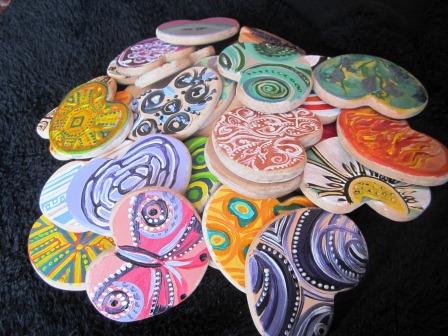
The set includes 50 wooden hearts, 7 cm by 5 cm, painted with acrylic paint. And so such equipment can be used both for therapeutic and educational purposes.
Here are some aspects in which you can use a set of hearts:
1. The work of a psychologist with trauma
2. Correction of psychosomatics
3. Psychoanalysis of the client
4. Dealing with ambivalences
5. Drawing up with the help of hearts of different stages of life;
6. For system constellations
7. Development of thinking and imagination in children
8. For life coaching
9. Transformation of infantile experiences
10. Overcoming transference neuroses
11. Working with protection mechanisms
12. Reflections of the socio-cultural attitudes of the client
13. Actualization of the individual characteristics of the client
14. Development of the client’s adaptive abilities
15. Overcoming victim attitudes and forms of protection
16. Work with stereotypes of thinking and behavior
17. Search for internal client choices
18. Work to find the constructive potential of the client
19. To resolve intrapsychic conflicts
20. Search for a compromise
Ordering hearts on the sitе
SYMBOLS OF THE HEART. The center of the being, both physical and spiritual, the divine presence at the center. The heart represents the “central” wisdom, the wisdom of feeling as opposed to the rational wisdom of the head. Both methods are reasonable, but the heart is also compassion, understanding, “a secret place”, love, charity. It contains blood, which is life. The heart is symbolized by the Sun as the center of life. The radiant Sun and the flaming heart are symbols of the centers of the macrocosm and microcosm, signifying man and Heaven, transcendent intelligence. The heart is also often depicted as a triangle resting on top. For the Aztecs, the heart is the center of man, religion and love, a unifying life principle. The sacrifice of the heart symbolized the release of blood, that is, life, the sowing of life so that it would be born and flourish. A pierced heart signifies repentance. In Buddhism, the heart is the essence of Buddha nature. Diamond Heart is purity and invincibility; a person whom nothing can “damage”, unbalance. In Chinese Buddhism, the heart is one of the Eight Precious Organs of the Buddha. Among the Celts, a good heart symbolizes nobility and compassion. The flaming heart as a symbol of religious zeal is the dominant element in the seal of Catholic Ireland. (1642). An inverted heart is a cabalistic figure by Jacob Boehme (1575-1624). The name of God written in Hebrew letters 1NUN is transformed into 1H5-NUN, that is, Yeshua (Jesus). is the antithesis of the evil eye. Christians have a heart of love, understanding, courage, joy and sorrow. A burning heart signifies religious zeal and commitment to the faith. The heart in the hand symbolizes love and piety; a heart pierced by an arrow is a contrite, repentant heart. The pierced heart is the emblem of Saint Augustine. A heart crowned with thorns is the emblem of Ignatius Loyola; heart with a cross – saints Bernardine of Siena, Catherine of Siena, Teresa. The heart of the Jews is the Temple of God. In Hinduism, the heart is the divine center, the dwelling place of Brahma: “This is Brahma, this is everything”, Atman. The heart is symbolized by the lotus. The “eye of the heart” is the third eye of Shiva, transcendental wisdom, the omniscient spirit. In Islam, the heart is the center of the being; “the eye of the heart” is the spiritual center, the absolute mind, enlightenment. In Taoism, the heart is the seat of understanding. The wise man has seven holes in his heart, and they are all open.
“The heart is that through which all knowledge is manifested”; “the creativity of the hands, the gait of the feet, the movement of all parts of the body – all this is done according to the command coming from the heart.” This is how the ancient Egyptian texts define the role of the heart, attributing to it functions that are now mostly attributed to the brain. As an organ indispensable in maintaining life and signaling in emergency circumstances with its rapid beating, the heart in many ancient cultures was assigned a role that, from a rational point of view, is not inherent. Of course, there is a big difference between a rhetorical image and its true expression. For the Egyptians of the era of the pharaohs, the heart was the seat of reason, will and feelings. The creator god Ptah planned the cosmos in his heart before shaping it with his word. At the Judgment of the Dead, the heart of the deceased is weighed on the scales with a feather (the symbol of Maat, Justice), to check whether it is burdened with monstrous atrocities; here “heart” is symbolically equated with “conscience”.
According to the Bible, the heart is the inner essence of a person, because a person looks at the face. God is in the heart (1 Samuel 16:7). Of God Himself it is said: “And the Lord repented that He had made man on earth, and was grieved in His heart” (Genesis 6:6). The New Testament tells us that Christ, by faith, should dwell “into your hearts” (Eph 3:17). In India, the heart is considered the seat of atman, the incarnation of the Absolute (Brahman) in man. Islam sees in the heart a physical center of spirituality and contemplation, clad in various veils. The Aztec empire was dominated by the idea that the earthly Sun, in its nightly wanderings through the lower world, had lost its strength, emaciated to the state of a skeleton, and could only be restored with the help of the blood of the heart of a ritually sacrificed person. The heart (yolotli) is considered the seat of life and soul. Before cremation, a green gem was placed in the mouth of the deceased, which was supposed to mean a heart. In the high Middle Ages, the heart was romanticized in love lyrics (for example, “About a heart scorched by love” by Rene d’Anjou), in the visual arts it was stylized, acquiring a pectoral shape far from reality at the top, and was put in relationship with both the earthly and the mystical heavenly love (in this case, as a mystical altar, on which carnal desires are driven out by the fire of the Holy Spirit). (Dictionary of symbols)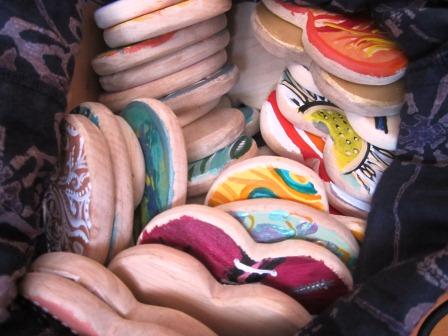
Articles on the history, fundamentals, applications, and various forms of art therapy can be found here.
Only the best offers, interesting company news, useful innovations and no spam!